
PHILOCTETES and the CHOICE OF THREE ISLANDS
- iamjamesdazell
- Oct 21, 2025
- 28 min read
Updated: Oct 22, 2025

INTRODUCTION
During the pandemic I set about writing my own translations of two of the least performed Ancient Greek tragedies by Sophocles: Women of Tragedy and Philoctetes. Neglected, I feel, because they’re misunderstood through our modern sensibilities, which resists its original context.
I designed the covers and editorial layout then had them printed in hardback versions. I then created a modernised vision of the work so the original meaning and dynamics of the play would remain accessibly comprehended.

I created several pieces of music for the video which is no longer being made, which can serve as music for reading this essay.
SECTION ONE: A LITTLE BACKGROUND ON THREE TRAGEDIANS, AND ONE TRAGEDY

All three of the major tragedians wrote a play on the same subject and episode of an embassy to Lemnos to seek out Philoctetes. Their source is from the lost epic The Little Iliad. And there is also a section of the surviving epic poem Iliad that mentions Philoctetes marooned on Lemnos. In Book Two of Homer’s poem The Iliad we had some information on the myth and we can assume this was the origin of all subsequent myths, and no doubt Aeschylus drew from this as he referred to his own plays as slices from the banquet of Homer, meaning his plays were embellishments from details and episodes that arose in Homer as his principal source of inspiration. This shows there was a very close relationship between epic literature and Greek drama. So, each tragedian had to find a way to translate the episodes of epic myth to the conventions and practicalities of the stage. Formally being a two or three actor drama with a singing group performing around five choral dances. Each tragedian created their own version of the traditional myth both to be creatively innovative and to adapt it to the limitations of the stage. Sophocles was the final dramatist to make his play on this subject. To emphasise that Sophocles has made artistic choices I want to briefly explore how they differ from those choices of Aeschylus and Euripides.

Since the subject is drawn from the epic cycle poems about the Trojan War, Philoctetes is a war play. It’s not an anti-war, but it’s also not a play about war. It’s a play about the human condition, where a war is the surrounding circumstance. Homer had always represented, not the value of war, but a perspective of life. A metaphorical way of perceiving life and a disposition through which to see it. It is this Homeric perspective that encircles the play.
Aeschylus’ play would have been written before 455 BCE. In adapting the epic legend for the stage, Aeschylus altered the Homeric account in order to heighten dramatic tension. Whereas The Little Iliad has Diomedes lead the Lemnos expedition, Aeschylus exchanges him for Odysseus as ironically both the instigator of Philoctetes’ exile and the leader of the mission to retrieve him. In Aeschylus’ version, Odysseus disguises himself as someone else, and manages to approach Philoctetes unrecognized pretending to be a fugitive from the Greek army. After gaining Philoctetes’ trust, Odysseus in disguise steals the bow whilst Philoctetes is in agony. Then reveals his true identity and commands Philoctetes to join him to Troy, persuaded by fate (necessity). The chorus in the play is made up of men of Lemnos but who had not visited Philoctetes throughout his entire ten-year time on the island.
All the elements of Sophocles’ play are there. Only it’s both too simple a plot and a psychologically improbable series of events. Probably because Aeschylus was dramatically more concerned with the music and poetry, the dramatic spectacle, rather than a plot or psychology of his characters. This is no flaw of Aeschylus, this was the greatness within his style of tragedy. Aeschylus was more concerned with form than realism and for that he practically defined the tragic form. Aeschylus’ complexity comes from finding paradoxes within the relationship between men and gods, rather than the internal conflicts within the human condition. This allows Aeschylus to make very simple plots that have enormous scale. We have a few fragments of quotes from his lost play. One from Odysseus’ character who says “ψευδῶν δὲ καιρὸν ἔσθ’ ὅπου τιμᾷ θεός” “There comes a time when deceptions honour gods.”
Euripides version of Philoctetes was produced at City Dionysia in 431 BCE as part of a tetralogy that won third prize. From this tetralogy, his play Medea survives, which is one of his greatest, so we can imagine the skill he worked on Philoctetes with. Euripides commences with a prologue by Odysseus. But, unlike Aeschylus’ version, Philoctetes has no desire to leave, now conditioned into this life of mere survival. Conventionally for Euripides, disguise was also used, as well as wit and rhetoric. In Euripides’ version, Odysseus was accompanied by Diomedes, in keeping with The Little Iliad. In this version, following from Aeschylus, the chorus were men from Lemnos who had not visited him either. But Philoctetes is supported by another character called Actor, a shepherd who despises the Greeks and even threatens to kill Odysseus. Also, not only the Greeks but the Trojans arrive too to prevent the Greeks acquiring the bow that the Greek embassy has come to retrieve. Euripides here uses the Trojans to create contrasts for debate. Euripides was as much influenced by Socrates as Aeschylus was by Homer. It’s Euripides who brings reasoning into drama. Music and poetry doesn’t reason, it just asserts itself. Homer, as a poet, was music. Aeschylus’ drama were vignettes of music with short sections of rhythmic speech. Euripides introduced plot and reasoning, and minimises the music in his plays and emphasises the acting, bringing drama much closer to what we understand theatre and acting to be. If you consider Plato’s dialogues of Socrates’ teaching, then you can see that Euripides has had a much greater influence on the direction towards modern theatre than the preceding origins of theatre.
Sophocles is somewhere in the middle. Sophocles’ play was produced in 409 BCE. Sophocles takes cues from both Aeschylus and Euripides. Unlike Euripides, the island of Lemnos in Sophocles’ version is uninhabited. Instead of the Trojan, or Odysseus arriving with Diomedes, Sophocles has Odysseus arrive with the son of Achilles, Neoptolemus. Sophocles may have found the disguise element to be insufficient dramatically, and innovatively replaced this with the inclusion of Neoptolemus, wherein he could debate the factions of personal interest. This time Philoctetes isn’t bitter against all Greeks but explicitly Odysseus, Menelaus, and Agamemnon. So, he welcomes Neoptolemus warmly, having great respect for his father. And even more so when Neoptolemus explains that he was wronged by Odysseus who took from him his rightful inheritance. There is still a moment in Sophocles’ play when a merchant arrives, and this may have been a character in disguise, even if it was not Odysseus but another sailor in disguise it would still have been played by the same tritagonist actor that played Odysseus.
The chorus of Sophocles’ play are sailors but they are also soldiers. We know this because of a description in the introduction Thucydides writes to his History of the Peloponnesian War when he describes the size of the Greek armies sailing to Troy. Referring to Book 2 of Homer’s Iliad, the catalogue of the ships, Thucydides says “the men not only rowed the ships but served in the army, as is made clear by the passage about the ships of Philoctetes, when [Homer] states that his rowers were all archers. Apart from the kings and the very highest officers, it is unlikely that there were many men aboard who were not sailors.” Thucydides “History of the Peloponnesian War” 1.10
SECTION TWO: THREE ISLAND DILEMMA
The original dilemma of Philoctetes is why I often think about this play. As modern audiences, we journey through a play through emotions and character. Dilemma is not the same thing as story, plot, character, or even themes. Dilemma is about the conflict between desire, limitations, and consequences. In some ways, dilemma is about prudence. The dilemmas in tragedy are profoundly existential dilemmas, but it is counter-balanced, by its visual stylisation and performance, its abundance of music, the beauty of its poetry. The eroticism of aesthetic transformation is what makes tragedy as an artform ecstatic. No other art form has since accomplished this because it requires a particular kind of poetry, a particular kind of music, and a particular kind of stylisation, a particular dramaturgy. Live performance in art is like a rubix cube – there are a lot of different ways it can be transformed, and when you change one thing you change everything. It’s very fragile in that sense. With each Greek tragedy I study, I’m always seeing it as solving the rubix cube. The essence of the structure of tragedy, utilising its form of aesthetic transformation, is a structure of recontextualization. This is something Western audiences struggle with because Western narrative is more about linear-conflict rather than contextualistion, which is more Asian drama.
The reason Philoctetes is marooned on Lemnos is because when the Greeks stopped at Chryse island on the way to Troy, a much smaller island very close to Lemnos,, a serpent bit Philoctetes’ leg near a shrine dedicated to the nymph, Chyrse. Tired of Philoctetes’ wailing in agony, the Greeks decided to abandon Philoctetes on the island of Lemnos before sailing onto Troy. During those ten years, Greeks and Trojans battled to a bloody stalemate. When the Greeks captured the seer Helenus, son of Priam and a Trojan priest, he disclosed the prophecy that Troy could be conquered only with the bow of Heracles which belonged to Philoctetes. So, an expedition was organised to Lemnos to retrieve the bow.
Though the stage of Philoctetes is the island of Lemnos, the play is not about Lemnos in a literal sense. It would be misleading of us to consider it an ‘island play.’ Truly, it is only the character of Philoctetes that is painfully aware of Lemnos as a desolate island. To the other characters, the location of the island of Lemnos is simply about where the bow is located. The location remains for them a means to victory at Troy. We can’t escape that Heracles, Odysseus, and Neoptolemus are all defined by some virtú in the military sense.
For Philoctetes, and the themes of the play more broadly, the island of Lemnos is evocative of Philoctetes’ existential expression. In the same way that Hamlet’s Denmark is a prison. Lemnos exists in relation to Troy, and therefore is a space absent from all the elements of a Greek hero. It is a space of degradation. As a dramatic performance. It is a blank canvas where after ten years of bitter resentment and perpetual survival Philoctetes has forgotten himself and needs to recall his own epic memory. An empty space of a stage by which images from beyond the space and time of the present location can be brought in. Invoking the past to the point where, ultimately by the end of the play, Lemnos is animated and Philoctetes’ idol appears, first in the imagination, then in the real.
The three key locations of the play are the island of Lemnos, the battlefield of Troy, and Philoctetes homeland of Euboea where he longs to be taken.

Though Philoctetes is not directly presented with the choice of these three locations, they each represent something different, and would lead to a different future if he were to choose them. The locations of Lemnos and Troy are only metaphorical extensions of a condition of being. It’s this aspect of the play that is so enduring for me. It’s a choice of oblivion, obscurity, or adversity.
In addition, like Achilles in the Iliad wanted to retire the battlefield to live a long life, so too, Philoctetes desires not the battlefield but to return to civilization. But Philoctetes must recognise and revive his already prior-developed heroic reputation and character. Neoptolemus must awaken his own destiny too. In the end, Heracles appears to speed them on to Troy, where these heroic characters belong. That is the only place that offers them the full scope of their greatness. Heroism has a larger purpose than idealised character.
Location matters in the story only in so far as what condition can be realised. You might have an inborn nature but you have to be actively involved with realising it. Announcing your genius where it counts for something. Genius is a kind of commodity, it has transactional value where it’s needed. Homer’s Iliad sets up the poetic metaphor of war as a metaphor for life and death. The Iliad is foundational to the parallel of Achilles’ inborn nature and Philoctetes’ inborn nature both being realised on the battlefield at Troy. To seek luxuries of comforts belongs to a degraded character. All heroes hope they don’t fall to such temptations. In the Odyssey, Hermes orders Calypso to release Odysseus from her pleasures and luxuries, in order for him to go on his journey of wandering sufferings because it is not his fate to die there.
Sophocles' Philoctetes transcends a simple narrative of persuasion; it is a profound exploration of existential choice, wherein three geographical locations—Lemnos, Euboea, and Troy—function as three distinct modes of being. Three incompatible modes of existence, each demanding that the hero, Philoctetes, betray either his personal peace, his heroic identity, or his very sanity. By viewing the locations through the lens of kleos and, Sophocles demonstrates that kleos is attained by means of suffering in course of heroic deeds and an Ecstatic alignment with the Greek polytheistic framework of the cosmos.
The drama of Philoctetes is ultimately the battle for the hero's condition or state of being, from existential to ecstatic played out across this profound geographical axis. His final choice to sail to Troy confirms the ancient Greek tragic structure that a polytheistic affirmation must prevail, not merely as a matter of authority, but as the source from which all life derives its highest ecstatic meaning.
Philoctetes’ time on Lemnos is an intermission of his life between his pre- and post-Trojan identity. After so many years of painful isolation, Philoctetes clings to his debased conditioning of mere day-to-day survival tactics, instead of claiming his arete or kleos aphthiton - imperishable glory - because his mind has made him feel fit for one space and not the other.
The island of Lemnos, where Philoctetes has endured ten years of agony, represents the space of Existentialism and Oblivion. The island of Lemnos is destitution, though he is remarkable to have survived, all it amounts to is a life of evading death for another day, merely postponing an inevitable. His pain, though immense, is privately consumed; the world has forgotten him, and thus his suffering yields no cosmic meaning. To remain where he is on Lemnos is oblivion of his memory at home and Troy, having left Euboea without participating in the war. Had the action of his life ended here, Philoctetes' life, despite his noble heritage and his divine bow, would have been reduced to oblivion. Total meaninglessness of an unfulfilled life.
He longs to return to his homeland of Euboea, to return to his family, which offers him comfort of luxuries but obscurity. It’s a rejection of his potential. It’s another kind of survival, but a passive survival of one that comes without any challenge. This small coastal town near Trachis ties Philoctetes longing to his idol the Greek demi-god Heracles, who had his deification funeral on Mount Oeta, where Philoctetes himself lit the pyre. The path to Euboea, Philoctetes' homeland, offers the seductive idea of a comfort with the relief of his present pain and loneliness. An Ecstaticism without kleos. Euboea represents the choice of self-limitation, a life valued highly by the individual but denied its full, glorious potential in the eyes of the cosmos. To choose Euboea, though he would once again be in the ecstatic world of the gods, is to sacrifice his destiny and his heroic identity for private contentment, diminishing a life of immense potential to one of deliberate obscurity.
His final choice to embrace the suffering of Troy is an ecstatic affirmation that the highest valuation of life, in the Greek tragic sense, is found only through the complete, agonising, and necessary fulfilment of his divine mandate. The landscape which stimulates and strengthens qualities of greatness is to pursue his idealised potential. A place of even more potential suffering than he faces on Lemnos. At Troy he has not only the war, and the prospect of death on the battlefield, but he must fight alongside those who abandoned him and betrayed him, who he hates the most. But it’s the only place where life asks for him. Where all his potential is needed. Where he has to show up and live up to his greatness. He cannot amount to his greatest potential in Euboea or Lemnos. This meaning of his greatness is relative to the adversity that he must go through. In all circumstances, his greatness is relative to his challenges and suffering, his adversity and resilience. But in such a way that his ations don’t result in mere survival but cumulatively results in his greatness. Philoctetes must choose the crucible over the comfort. Not just any crucible, otherwise he would stay where he is, but the right kind of adversity which is represented by Troy. Eventually, Heracles compels him to make the prudent choice to go to Troy. It’s not insignificant that Heracles is the one to usher him onward to this choice. Heracles is a personal hero of Philoctetes, and Heracles had already accomplished the task of sacking Troy decades earlier, which the Greeks now aspire to. This is why Heracles is mentioned throughout the Iliad, as a representation of epic memory to the Greeks.
The tragic dilemma here is not merely choosing purpose over peace, but also the cosmic context over personal passion: The tragic dilemma of Philoctetes is crystallized by the three locations: the hero must choose between his existential resentment and utter oblivion on (Lemnos), the comfortable passive life at his home on (Euboea), or fulfilling the potential of his greatness at the cost of immense suffering at (Troy).
The arc of the play is that Philoctetes must attain an ecstatic outlook on life to overcome his existential dilemma he has been conditioned to on Lemnos. One that is not life seen so personally but one with the full context of the gods' designs. A perspective of life where suffering is going through the crucible of life to a greater outcome. The structure of tragedy is basically already in the epic cycle poems, we already see it in the Iliad and the Odyssey. The performance of drama elevates epic by confronting reality with aesthetic transformation; beyond solo music, song, and poetry, to a live communal performance of dance. Narrative isn’t the right way to understand tragedy. Tragedy is a muralism. Tragedy is a heightened and stylised musical-visual statement, that serves to evoke rather than represent.
The path to Troy is the only route to complete Ecstaticism and kleos (glory), but it is his hardest choice, as it demands he put aside his personal resentment in favour of a higher purpose. To go to Troy demands that Philoctetes not only endure continued hardship rather than being relieved of it, but must actively suffer for such potential alongside the very men who caused his present suffering. Therefore, to achieve the ultimate affirmation the full summit of his potential at Troy, he must renounce his existential condition, his taking life too personally, and see it larger in its cosmic context instead. The necessary, difficult path to Troy, finally, is the only route to complete Ecstaticism and kleos (glory).
The intervention of Heracles in the play is essential, not merely as an usher of heroic necessity, but because no other god has more of a personal connection to Philoctetes, and through Heracles Philoctetes sees the greatness of himself as also a man who can take Troy with the very bow Heracles did, which Heracles had previously presented to Philoctetes as a gift. Heracles is the epic memory of what Philoctetes now aspires to become in his potential (which is fated to be achieved at Troy). Troy does not promise the end of suffering—it demands its transcendental application. Heracles is also someone who attained his glory through his suffering. By choosing Troy, Philoctetes submits to the prevailing structure of the gods, affirming that his life is so valuable that it must be utilized for a purpose greater than his own desire for revenge or comfort. This act is the ultimate heroic self-affirmation, turning private suffering into public, immortal meaning. The tragic movement thus charts the hero’s passage from meaningless agony on Lemnos to a necessary embrace of glorious destiny at Troy, demonstrating that only by embracing suffering as adversity and resilience can the Greek hero achieve maximum kleos. The arrival of Heracles validates Philoctetes' decade of anguish, revealing that his intense pain was the required prerequisite for his unique, essential role in the divine plan. More precisely Heracles arrives to him because he has finally regained his acceptance of the gods. We notice the barrenness of the island that was characterised at the beginning now seems to be full of activity by the time Philoctetes gives his farewell speech.
Though the play isn’t about war per se, it carries the same Homeric disposition through its themes. One of the most important is this idea of epic memory. Throughout the Iliad we find references to Heracles. This is not only because he is the quintessential Greek hero, but also because Heracles had previously sacked Troy, so the Trojan War of the Iliad is, to the Greeks, a recreation of an epic memory. Philoctetes is all past, present, and future. The glory of his future, the greatness of his past self, and the survivor his present destitution. He is a character out of sync with himself due to the conditioning of survival in a place he has spent the past ten years that is not right for him. When Philoctetes chooses self-imposed exile and intractable anger, he is essentially attempting to live outside the gods' purview. This act, in the ancient Greek worldview, means rejecting the very structure that gives his life meaning and worth. By Neoptolemus talking with Philoctetes about those Greeks he knew who are no longer alive, Neoptolemus is recalling an epic memory of them in the mind of Philoctetes, which reminds Philoctetes of the importance of kleos, since he was surprised to learn no one knew about him. This brought Neoptolemus and Philoctetes in contact with the ‘spirit-world’ of heroes, those ghosts of the past to which ancestral worship is so important. Being remembered and being forgotten is a theme here too; as not forgetting, and being remembered is why myths exist at all. Life being inevitably mortal, perishable and limited, the Greeks preferred to be immortalised by being remembered in song and stories. Philoctetes weeps at the death of his former friends but of course, it is at their death how they acquired kleos at all. After introducing himself, Philoctetes was saddened that he himself had no renown, was unheard of – despite this was not the case as Neoptolemus knew of him very well. Philoctetes was distraught that no one knew of him, that no word had reached Troy, his homeland, nor anywhere else among the Hellenes despite having passed messages to passing sailors. because he hadn't fought at Troy yet. Over time of the play, and the anger Philoctetes has towards Odysseus, Philoctetes rediscovers his own condition of his former self. All of this culminates in the manifestation of the greatest dead warrior, and they invoke him first by their words of memory and then in person. This intervention of Heracles is a manifestation of this achievement Philoctetes has attained, and therefore he accepts that his destiny and his value are inseparable from the divine will. The heroic spirit world surrounds the play. By choosing to go to Troy, he is not just obeying a god; he is rejoining the ancient Greek valuation of life by accepting the necessary path of suffering and fame. Therefore, the victory in the war and the acquisition of kleos are not merely plot points; they are the external confirmation of Philoctetes having successfully endured the crucible and solved his internal, existential dilemma by embracing a grander, divinely structured view of life and suffering.
Life is valuable in itself. That is testified by the polytheistic religion. The polytheistic religion values life higher than a monotheistic, because the polytheistic consists of every aspect of the human experience including things which together make life difficult, ironic, paradoxical and contradictory, alongside the beauty and fulfilling aspects of life. The plurality of gods means everything in life is valued since every god wants veneration. All aspects of existence are valued - both the suffering and sublime. So, if Philoctetes rejects the gods then he rejects that valuation of life. He had to accept them to rejoin the ancient Greek valuation. This high valuation of life is expressed by the framework of polytheistic gods. The structure of ancient Greek tragedy always is that the gods prevail, represented by the Chorus who always survive and close the play.
“That the conception of gods does not, as such, necessarily lead to that deterioration of the imagination which we had to think about for a moment, that there are nobler ways of making use of the invention of gods than man’s self-crucifixion and self-abuse, ways in which Europe excelled during the last millennia, – this can fortunately be deduced from any glance at the Greek gods, these reflections of noble and proud men in whom the animal in man felt deified, did not tear itself apart and did not rage against itself! These Greeks, for most of the time, used their gods expressly to keep ‘bad conscience’ at bay so that they could carry on enjoying their freedom of soul: therefore, the opposite of the way Christendom made use of its God.”
– Nietzsche from On the Genealogy of Morality, second essay, aphorism 23
An Internalised High Value of Life⟹
This stimulates a desire to increase strength⟹
This creates a goal to maintain high strength⟹
⟹A new meaning to Life maintains the goal.
Suffering is a physical impulse so that we live more. Whereas pain wants us to stop doing something, suffering is different; through suffering we desire to grow. This suffering becomes the crucible for further achievements.
SECTION THREE: CHARACTERS
Despite an obvious seduction to compare Sophocles’ Philoctetes to Shakespeare’s The Tempest, Philoctetes is nothing like Caliban, Ariel, nor Prospero. He has no parallel with The Tempest. In some ways, he is closer to Hamlet; the irresolute, brooding, and grieving hero self-inhibited from taking action on his circumstance, trapped by his own state of mind.

Throughout the play, Philoctetes is in bouts of pain that rise and subside. As much as I imagine Sophocles wanted his audience to sympathise with Philoctetes, there’s not enough dramatic arc to that interpretation. Rather, his pain has woven itself beyond the physical bite into his very bitter psyche in how he sees the world. Lemnos is an expression of his existential conditioning, and his snake bite, and is not a symbol of his physical state, but a literal metaphor of his psychological bitterness that ties him to that condition.
The matter isn't why can't Philoctetes leave Lemnos, or then it would be an existential matter. He can leave Lemnos. But only under certain conditions. Honour and piety, having regained his former excellence of Greek warrior. The episode of the theft of the bow disrupts his stable existence of destitution and realigns him with himself. It's not that Philoctetes had to get into the Jungian shadow of his mind and confront his psychological issue. Rather, he needed to externally condition himself with an exchange of location. He must no longer be right for Lemnos, he must be right for Troy.
In the Homeric poems, arete is frequently associated with bravery, but more often with effectiveness. The person of arete is of the highest effectiveness; they use all their faculties—strength, bravery, and wit—to achieve real results. In the Homeric world, then, arete involves all of the abilities and potentialities available to humans. This notion of excellence was ultimately bound up with the notion of the fulfilment of purpose or function: the act of living up to one's full potential.
Similar to Achilles in the Iliad, Philoctetes must move past his brooding resentment towards the Greeks and realise the potential of one’s inborn nature, reawaken his inborn genius as a man of war, a heroic warrior who can make all the difference at Troy. His greatest self is only found in spaces of courage and action, but he clings to his brooding resentment and wounded pride, having been averted from what he truly is.
Let's recall how Philoctetes appears in the wider myths. A monument of a Greek epic hero. Philoctetes is an unmovable mountain, as cold as a night wind, as stubborn as his agony, and as hot-tempered as his fireside. Philoctetes is a remarkable and pious warrior. Of all those who sailed with a fleet to Troy, unlike Odysseus and Achilles who tried to get out of going to war, Philoctetes went willingly with seven fleets.
When Heracles died, Philoctetes lit the funeral pyre of Heracles when no one else would. For this he was awarded the sacred bow made by Apollo, the very bow the pair have come to retrieve. When Philoctetes arrives to Troy, it is this bow that Philoctetes will use to kill Paris and conquer Troy. After Troy, Philoctetes would go on to Italy and become the founder of several cities.
So, why do we perceive Philoctetes to be a King Lear, or as The Temptation of Saint Anthony by Bosch or Carracci, an underdog lower-class hero, so beaten and disabled? He isn't a homeless man, or a working-class hero, or a bad man that must become good, nor the representation of the good man of society.
He is a strong man brought low by his own derangement of pain and anger. More like Colonel Kurtz from Heart of Darkness, and Apocalypse Now, not in character but in departure by mania from his excellence. A distortion of his character. He's a great man who is eaten up with madness after years of nomadic survival. We must understand it as a kind of derangement. Philoctetes was a legendary warrior; who can survive in this barren, heat-beaten, wild world, battling against the raw elements of nature for ten years. One imagines Akira Kurosawa and Toshiro Mifune would have made a great work of it.
It's plausible that Sophocles based his characterisation of Philoctetes on the god Hephaestus. Lemnos is a volcanic island in the north Aegean Sea and relates significantly the Hephaestus. It was his favourite place in the mortal world. The city of Hephaestia was named so in honour of the god Hephaestus, whose cult was maintained on the island of Lemnos and was once the capital of the island during the 8th to 6th centuries BC. We picture him like Hephaestus at the Forge by Guillaume Coustou the Younger. The earliest of his representations of Hephaestus were dwarf figurines that the Greeks would place near their hearths. During the best part of Greek art, he was presented as a vigorous man with a beard and is characterised by his hammer or some mechanical tool. At Athens, there was a famous statue of Hephaestus by Alcamenes in which his lameness was only subtly portrayed.
His life over ten years on Lemnos has created another Philoctetes that forgets himself. He admires that he has managed to survive and the way of life he has created of survival. He wants to go, is glad to, and then he suddenly seems sad to leave. His defiant identity against death is attached to the place that oppressed him.
Philoctetes is actually the antagonist, as is every tragic figure. The Chorus, the protagonist, understand this Lemnian condition as a voluntary attack by an overindulgence into resentment. That he corrupts his own mind by self-pity, his wounded ego ashamed before itself. Indeed, he craves the validation of pity, and what benefits it might bring. Sophocles has written him both as a man who suffers and an insufferable man. Philoctetes as he is portrayed is not the example of a ‘good man.’ Philoctetes on Lemnos represents the corrupted man.
The chorus does not let Philoctetes accept his plight is the fault of others.
They say "it is you, you yourself ill-fated man that have so decreed. This fortune which you are captive comes not from without or from a stronger hand, for when it was in your power to show wisdom your choice was to reject the better fate and accept the worse."
In fact, Philoctetes in his laments proves that his strength from the bow was the means that kept him on Lemnos. For it was his means merely to perpetually survive that facilitated his base existence. He overcame his threats of ruin but at the expense of danger that made him strong and powerful before.
Philoctetes says "it was your hope to take me to that Trojan land which I abhor."
"So I deemed it best." the chorus reply.
Neoptolemus is the deuteragonist. As the son of Achilles, he represents the young boy in a rite of passage to manhood, and still in aspiration, who hasn't yet accomplished arete. Neoptolemus is not the central character of the play, but serves the tragedy of Philoctetes, as Antigone had served the tragedy of Creon. If the play were centred around Neoptolemus’ moral right and wrong decision, then the entrance of Heracles loses its significance to the unfolding drama. Neoptolemus is not necessarily the balanced middle between two extremes of Odysseus and Philoctetes, since his is an extreme of his own desire for personal glory to live up to his father, Achilles. Therefore, we see Neoptolemos doesn't go over to the position of Philoctetes, but instead attains the noble countenance of his father, Achilles. For he returns with a strategy of his own, this time without the treachery, yet still rising up to the status of a shrewd military leader as he was promised the reputation of.
If we see the most profound moment of the play to be when Neoptolemus decides to give back the bow and take Philoctetes with him, then the play can only fall flat at the end. The most profound moment must be the appearance of Heracles, as the natural culmination of the themes of the play. As for Odysseus, he is not the antagonist he appears to be, but the tritagonist. Odysseus represents the condition of the Greek military excellence. The condition of men where Philoctetes is destined to go to. The condition Philoctetes needs to be to fight at Troy. But Philoctetes aspires higher than Odysseus and Atreides, towards Heracles.
Sophocles, having witnessed at least two versions of the overall same plot brought to the stage, handled by two masters of the art - Aeschylus and Euripides. Having made so many innovations that revise dramatic problems in earlier versions of the play, it seems improbable that Sophocles made a dramatically clumsy mistake in Heracles’ appearance at the end. In essence, Heracles’ entrance denies even the idea of a universe of moral imbalance that distinguishes between moral right and wrong, virtues of pity, vices of pride, guilt, and redemption. The divine world of Greek polytheism overhangs the play at every corner. There are simply quiet gods, not yet sufficiently invoked by Philoctetes until he accepts them. Until eventually the one who appears to him, is the one closest to him, his role model for who to be in the world. As he reclaims his inborn nature, his role model for that nature appears the one who gifted him the bow that was key to his survival and his courage.
SECTION FOUR: MODERNISATION
A problem with modernising Ancient Greek Tragedy is we're dealing with sacred drama. Ancient Greek tragedy, particularly in its Sophoclean form, functioned less as a psychological drama and more as a religious and civic ritual aimed at revealing the terrible, beautiful logic of the cosmos.
The true power and meaning of the play—the "ecstatic dilemma"—is often lost on modern audiences because we navigate a play by observable, staged elements (character, emotional, plot points arc) rather than accessing the unseen contextual framework of mythology that the ancient Greeks took for granted.
It is always our modern emotions for Greek Tragedy that distort the work, compared to when one brings in the broader context of the religion into the subject matter. Tragedy isn't like Shakespeare or the novel where the play is the thing. In those, the story is self-contained between its opening and closing. Tragedy is a detail from an interlocking myths that criss-cross through the play, and stretch beyond it. Each play is a star in a galaxy. It is as if a detail from a larger painting. Political, artistic, and philosophical, but above all, religious. The most crucial elements often existed entirely in the imagination or in memory.
Modern audiences, steeped in a tradition of realism and psychology dating from the Renaissance, often misinterpret tragedy by applying the following expectations:
A Focus on Emotion over Pathos: Modern audiences expect the drama to focus on the character's emotional and psychological realism, the existential condition of a character. The Greeks focused on the polytheistic framework that affirmed the ecstatic condition of the cosmos and human experience.
A Focus on Plot over Prophecy: Modern audiences seek novel twists and character-driven motivations. The Greeks looked for a character’s realisation to put them back into alignment with a divine ruling of the cosmos and human behaviour.
A Focus on Individual Subjectivity over Cosmic Context: Modern audiences look for the hero’s self-made journey. The Greeks looked for the hero's place in the cosmic hierarchy. If Philoctetes were a modern hero, he'd find happiness in Euboea and reject the flawed system; the ancient hero must, ultimately, accept the system to achieve timeless kleos.
I’d like to briefly discuss three key modern versions of Philoctetes and their pros and cons:
Kate Tempest’s Paradise (2021)

Kate Tempest’s 2021 version of Philoctetes was re-titled Paradise. Kate Tempest made Lemnos a refugee camp. However, a refugee superimposition doesn’t work because the characters are literally going to war, not fleeing it. Tempest’s all female actors was an attempt to undermine the masculinity of the piece. Yet Tempest had Philoctetes, instead of not having the military condition because it’s been eroded out of him through me survival on Lemnos, Tempest made him an arrogant military figure. Wherein Philoctetes was commanding and thick skinned, even in destitution and nothing much beneath that. Tempest had Neoptolemus as a reluctant soldier instead of being self-righteous, audacious, and glory seeking. Regarding the audible execution, all the characters always shout making the speech unpleasant to hear. The Chorus were not male sailors and soldiers, but women living in shanty towns. They were presented making teas, as the women in contrast to the 'men'; appearing actually comic and digressive from the story. Rather than Heracles appearance at the end of the play, Philoctetes kisses a chorus member that had been onstage all the time. Unfortunately it shows a total lack of understanding of the play so none of its modernisation works.
Jean-Pierre Siméon’s Philoctetes (2009)

Earlier in 2009, the French playwright Jean-Pierre Siméon wrote a more successful variation of the play. However, the translation into modern French was quite pedestrian, lacking poetry as an attempt at naturalism. Poetry was fundamental to tragedy but especially Sophocles’s late works. His late works were transcendental utilising music and heightened poetry to transcend the ordinary into the extraordinary. For myself, Siméon’s translation was very flat. Yet the 2009 production for the text by director Christian Schiaretti is a superb modernisation, with brilliant scenography by Fanny Gamet and costumes by Thibaut Welchlin. The visual contribution of the staging helped achieve some of that stylisation but there was no music and it lacked the poetry of Sophocles’ original text.
Seamus Heaney’s A Cure at Troy (1990)

Written for, and first produced by, the Field Day Theatre Company in 1990, Seamus Heaney retitled his version to A Cure at Troy. This was Heaney’s first venture into the field of drama. His attraction to the adaptation was the struggles in Northern Ireland and perhaps apartheid in South Africa. Despite his famous chorus of "History says..." (quoted in Joe Biden's 2020 Presidential campaign), the first thing I noticed was that Heaney uses the chorus in the way that Seneca misunderstood it, as a kind of philosophical commentary on the thematic action of the play. Dispensing with Sophocles’ common prologue of a plan of action dialogue between inferior and superior characters, incidentally, dispensing with the formal Parodos too. Heaney instead opens with the chorus first - effectively a Shakespearean prologue, rather than anything of Greek tragedy. The meter and tone which he translates the play into is so dry that it is much closer to satyr-play rather than Greek tragedy. Heaney entirely discards the appearance of Heracles at the end of the play due to making the most profound moment of the play the return of the bow to Philoctetes. Therefore, Heracles’ participation in the play presented Heaney with no meaningful dramatic substance, simply utilising the choral leader in his place.

In 2023 I completed my Spanish version titled Aquilito (Little Achilles) both a reference to the epic memory of Achilles within Neoptolemus and The Little Iliad which is the source of this myth. I have Philoctetes refer to Neoptolemus as Aquilito as an endearing fatherly nickname. I used this Spanish version to revise my previous English version now titled The Achaean Turn.
A Vision for Aquilito:
To modernise, I tried not to update the drama or project topical ideas or modern political sensibilities, but simply find parallels with narratives that we would be familiar with to be able to perceive the dynamics of the play in a contemporary vision.

My vision for the play still takes place on the island of Lemnos’ and retains its environmental degradation to visually embodies Philoctetes' own destitution and degraded existential condition, showing his physical decay as a direct reflection of his mental state, much like Colonel Kurtz's outpost in the film Apocalypse Now or more precisely Joseph Conrad’s Heart of Darkness. Like Colonel Kurtz, Philoctetes formally had the reputation of an excellence warrior, who has been surviving in a remote location, away from the army. After being abandoned after a wound, there is an expedition sent to retrieve Philoctetes’ divine rifle that has bullets that never miss their target. He is not pitiable; he is strong but consumed by resentment.

Like Apocalypse Now, a patrol boat brings Odysseus and Neoptolemus to Lemnos, serving as a modernisation of the Greek trireme ship. Odysseus, still a ruthless, cunning, mentor, draws influence from characters like Denzel Washington's Alonzo Harris in Training Day or Al Pacino’s in Donny Brasco. He is the embodiment of necessary military virtú—the State's unfeeling will to personal law that becomes lawlessness. Neoptolemus is the conflicted rookie, like Ethan Hawke’s Jake Hoyt in Training Day as the rookie under the wing of his mentor, or Donnie Brasco, forced into an ethically complex undercover operation that challenges his code of honour. These are dynamics we’re familiar with from modern culture that allow the audience to accessibly grasp the dynamics and the world of it, to then be able to grasp the themes at play.
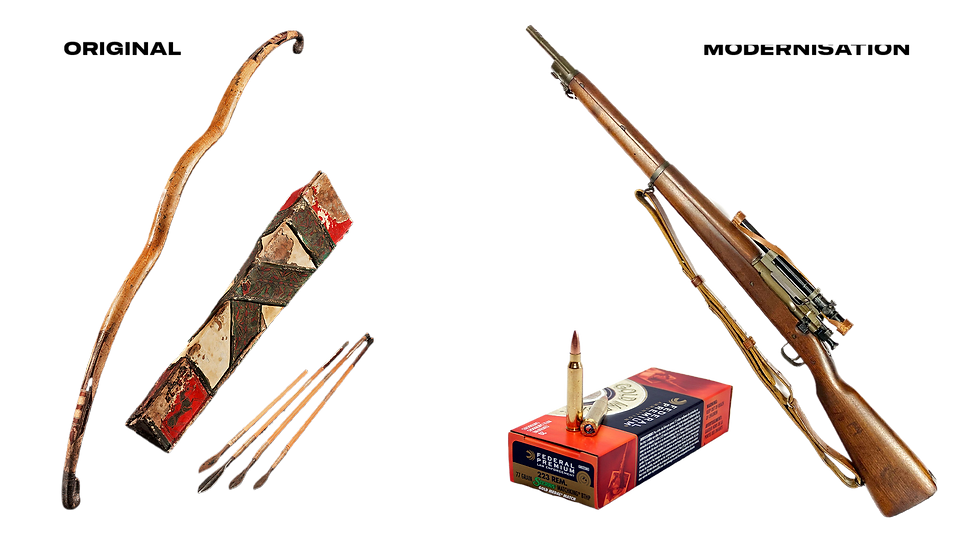
The appearance of Heracles as an hallucination experienced solely by Philoctetes and Neoptolemus, the feverish climax of his decade-long mental struggle and isolation. Which if on-stage I would do as Joseph Bennett created the ghost of Kate Moss for the Alexander McQueen show.
As Philoctetes reaches his breaking point, the soundscape ruptures. Heracles manifests as a figure of ultimate, historic military authority. His voice is amplified and distorted, delivering the Sophoclean text as cosmic law. This sudden, internalised intervention forces Philoctetes to realise that his personal rage is secondary to his immortal kleos, compelling him to perform the final Ecstatic Affirmation and choose the Crucible of Troy over the obscurity and comfort of his family home, or the existential affirmation towards the oblivion on Lemnos from his own bitterness.

Comments