
The Importance of Reading
- iamjamesdazell
- Nov 13, 2025
- 14 min read
Updated: Nov 17, 2025

I recently visited the largest bookshop in the Northwest of the country, deciding to review the shelves under the New Fiction section, which I hadn't explored for a long time. When I visit bookshops, I browse by starting at one end and work my way across each row, reading the titles, synopsis, sometimes a few pages, until I’ve wandered through the entire section.
On arrival, my first impression was that publishers have been the first to ignore the phrase "Do not judge a book by its cover." They now seem to insist that we do. English bookshops now appear more like toy shops, magazine stalls, exhibiting book covers as garish as sweet shop candy wrappers. No longer seeming like the sophisticated cultural objects they once were. Leafing through a few books in the bookshop, the current endemic of low attention spans was evident. The books are thinner; the text is bigger; chapters are the length of merely five pages instead of fifty. The back covers of books are no longer informative about the author or a synopsis of the subject matter of the book, but only testimonials from trade reviews telling the prospective reader what to think before they've read it.
I journeyed from one end to the other selecting mostly by the title or an interesting author's surname, which I've come to believe is a good way to anticipate a book that will come to mean something to me. The more of a statement the author makes with the title, the more likely the title conceals what the author has to say and reveals the character of their literary style. However, reading through a few pages of many books from the first to the last, it was clear — and with disappointment — that the books were little more than airport fiction, and potential prime-time television drama. Books which twenty years ago we looked down upon as a lower standard of writing and would never be considered real literature. In short, books which merely serve to entertain. They all seemed to involve a death or a scandalous extramarital affair like some midday TV melodrama. No doubt, these books will end up left behind in a hotel room on someone's European summer holiday.
Where was the poetry, the philosophy, the urgent voice of our time beneath its surface, the curiosity to experiment with literary form? Instead, it seemed to belong to the very thing literature aims to evade.

I would blame the publishers solely, but in England, and other parts of the Anglosphere, there is another beast that is the hindrance to literature of good merit. The agent. The agent is someone whose whole business is to situate themselves between the author and the publisher. To sift through unsolicited manuscripts - as a kind of service to the publisher - to then decide what books the publisher should receive. The agent gets paid by taking a cut from the advance that the publisher offers the writer. But therefore, the agent has no interest in books that don’t receive a large advance, as potential sales determines the size of the advance payment. Since this is the source of their income, it's to the interest of the agent to choose the most commercial books possible. Literary books are hard to sell, and therefore the most commercial are always the least literary. In France, this is quite different, a writer may submit their manuscript directly to the readers of the publishing house.
The publishers don't escape criticism, as they have an interest in producing and selling books. As does the retailer. Both would sell blank books if they would make a profit. Whereas once upon a time a publisher would find a talent and then develop them in-house, allowing for them to experimentally explore their voice, themes, and form, eventually making a name for themselves as somewhat of an artist of the pen. Nowadays, a publisher's role is to find a writer who has already achieved success by their own efforts (usually by social media or being a relevant celebrity, where there is already a popular foundation to market the book) and then swoop in to capitalise on that market success by making it more appealing, more juvenile, and inoffensive to a mass audience. The publisher simply aims to sell copies of what it produces like any other capitalist business. Books are its capital, not writers. They are solely in the business of selling books not being a patronage to writers.
Furthermore, both publishers and agents want a masterpiece to land on their desks ready made. They don’t want to risk investing in a writer’s talent, because that’s not the product. Of course, since each publisher is a brand, and publishing follows the market, what they choose is very similar to what they’ve chosen before. So, everything ends up relatively the same. This is a consequence of twentieth century mass production. Admittedly, the idea of paperback books by Penguin in 1935 was brilliant. To print the classics of literature in an affordable form. It’s as important as the invention of the biro. Reading and writing significantly increased across reading populations. But the business model that it's attached to, simply differentiating between books harder or more convenient to sell, means literature was inevitably going to get less and less literary. Publishing tends to follow markets, whereas great writers tend to be highly individualistic, like a painter or a composer, and rather than markets, a writer's body of work was inherently connected to a specific author, and it was imperative once upon a time to craft that individuality. Think of the great Russian writers, they all had unique voices and were each doing very different things. An undeniable consequence of this is that the novel is not only the predominant form of literature today. It’s the only form that is outside of non-fiction. Of course, there are short stories, but they are basically what the calf is to the cow.

I realised whilst reading through many books, picking up a few, tucking them under my arm, that I don't read because I am trying to find writers. I read because I have a desire to write. I have a desire to practice a language and style of writing, which I train myself by reading those who write like I wish to write. This is more important than simply learning to write, but that certain stories can only be told through certain language. Just as certain interpretations of the world can only arise from certain frames of mind and wellness of health.
In the past, literature belonged to a time and place. The poetry of Philip Sidney belongs to 16th Century England as much as John Milton’s poetry belongs to 17th Century England. Dostoevsky is Russian literature, and we cannot read it as if he were an American or Chinese novelist. Literature belongs to places, belongs to the author’s and a nation’s disposition, energy, character, aspirations, and more. But it reaches an atomic level of individuality that it shares both with its people and humanity. If literature, like Shakespeare, can feel to belong to anywhere it is due to the truthfulness of the world, which is more of a timelessness than a placelessness. Literature no longer belongs to anywhere, because it belongs to everywhere. The internet is a nowhere space and its authors are placeless.
The internet values, not geographic locality, but conformity and cohesion. One can be popular online, but not individual. Its social landscape fuels insecurities and the popular writers are those who give readers their insecurities back to them in sympathetic validation. The algorithm wants repetition and assimilation. The internet doesn’t have culture, only trends, which are born nouveau and die passé. A writer’s role is to unmount us from the decorum of social reality and return us to that atomic level of humanity.
I don't mean to suggest screens are the problem. We have the world's largest library at our fingertips via the internet. Project Gutenberg, Adelaide University, Perseus Project, JSTOR, are just a few resources alone that have opened my mind to literature more broadly than anything solely from a visit to a bookshop. Even the 19th century essays of Ralph Waldo Emerson, the only physical copy I see is Modern Library's edition of a small selection. Whereas I can read them all online for free. I would print them out and make my own compendium. It's the way we absorb and connect to words. We retain less when reading on screens than in physical forms. There is a quietude and intimacy with a book that's not had with a screen. A screen is a kind of passive reading to soak up words like a sponge more as information than experience.

Generally speaking, with few exceptions, it’s books written before the 1960s that still hold any literary interest with me. And translations no later than the 1970s. Penguin Classics and Penguin Modern Classics are thankfully very good at shortlisting selections of books worth reading. I found a few books. Each of them, I heard my own voice, my own language. I have about five or six bookcases at home, but one in particular that hosts the canon of my favourites. I like specific periods of literature. The high modernists, the 19th century Russians and Romantics, the French symbolists, the French and Spanish Baroque poets and philosophers, the English writers of the 1580s, the Italian writers of the 14th century, the Heian, Muromachi, and Edo period Japan, the gold and silver age Romans, and all the Greeks until the fourth century BC. Yet I started out more contemporary American, reading Don DeLillo, Charles Bukowski, and Douglas Coupland. Writers I'm affectionate for but will never read again, having transgressed that era of my affinity. They write of a world I no longer have any spiritual identity with. I no longer see the world or myself in their writing. In reading, I am essentially looking for myself. It seems cinema took over the novelist in the latter half of the 20th century. Cinema was the art of the 20th century as much as the novel was the art of the 19th.
I'm concerned we are losing the importance of reading. Unlike our music, our cinema, and our contemporary performance art, a book does not perform. The reader performs. The book instructs the reader to their performance. It does not give; a reader is active in the work of making those words alive. The words on the page are merely a kind of braille or musical notation, and the brain is the instrument that dictates or plays the music. The biggest hurdle to a healthy reading culture today is noise and distraction. To decide to read a book and sit comfortably to enjoy it, a quiet atmosphere is necessary. Reading is an exercise in contemplation, in stillness, in silence, in solitude. The world is in a constant state of urgency for our attention and to fill in the gaps of all and any silence with noise. One competes with the invading sound, not of street musicians which can be a pleasant sound to read against, but the noise of public radio, and electronic devices. An invasion of noise as though there is a mission to eliminate silence that gives rise to a moment of free and individual thought. Reading is also a refined exercise. If In public, it requires polite company, to prevent a concentration broken by an ambush of vulgarity.
One needs at times to participate in the world and at other times to stand back and observe it in contemplation. Reading is a kind of stepping aside temporarily and observing the world in insightful contemplation from a position of prudence, like a sports coach that observes the game from the sidelines, like a theatre director watching a play from the wings. Reading stimulates the imagination, concentration, and critical thinking. Reading is a kind of exercise of thoughts. It is an exercise of familiarising oneself with one’s own soul. An exercise in empathising with the soul of others. Writers allow us to stop thinking in particular, and practice thinking more generally; soothing us from our daily troubles and ruffled lives. So, we should only read writers who could potentially think better than ourselves or at least think like ourselves, or speak of the world the way we wish to speak of it. You will find, after reading a good book, a better understanding of the world and your relation to it.
Books are the history of human thought. They evade the circumstances of the day and allow us to revisit thoughts in social, religious, political circumstances other than our own. To resist the limitations of country and character. To roleplay another human being, perhaps from another time and country, and live it as if it were our own soul. They broaden the human experience and raise its potential. A whisper is lost on the wind, but the pen makes a silent word immortal.
Good books are there to remind us of some timeless sense within a world of present chaos. At first, we are always drawn to books that speak to the way we feel. Later, we are drawn to books that present the way we would like to feel. At first, we find ourselves, then explore what else we can become; testing out personalities like new coats.
Reading is so important to do when you are young because it gives you a way to feel the world, as well as seeing it; a way to see life before it happens. to explore and discover yourself before you embark in the world. Within every feeling is a thought. Within every thought is a disposition. We ought to be drawn to a book for the way the author holds themselves up against life and has themselves observed the world with some penetrating insight. Expressing it simply, insightfully, and sensually.
The world we live in is chaotic. Though all men in their own times have probably also said the same. The book was invented as a kind of private temple. A way to contemplate in a spiritual sense outside of the religious centre. Until the modern age, books were read aloud, and rarely in private. Books are a dictionary in context. Emerson called language "a tomb of muses." The poetry of literature, including prose, is an exercise in refined and useful words and phrases which make their way into common speech—at least of those well-read—and preserve language its dignity, sparing it of the erosion from illiterate colloquialism and folk abbreviation.

I never understood people who buy a book to read once. It's absurd to imagine a great piece of music written to only be heard once. A book should be a conversation you want to re-live. A book to be read once was not worth reading the first time. You read a book firstly to know the book. Then a second time to engage in a silent conversation with its author. Its pages can never be read the same way twice. You will never read the first page of a book the same way once you have read the book in full. To read it again is to be in the company of its new understanding. Just as with a great piece of music or a cinema, once you are aware of where it is going, all its turns and surprises, you no longer spend time concerned with that. You savour the book ever more each time you read it, for the moment of each page. You are in no hurry. You read to enter into conversation with its author.
Reading culture is also hindered by the frequency which we read quotes instead of books. Quotes merely serve to caption a photograph or are now often the whole image itself. I’m cautious of quotes. A quote is like a detail of a painting. The touching fingers of Michelangelo’s chapel doesn’t convey the magnificence of the whole work. A quote doesn’t reveal much about the person who said it. For example, many quote Dostoevsky, but Dostoevsky was not writing a journal. He was an astute psychologist of fiction. What he put into the mouth of a character was very deliberate for the context of that character, and neither an aphorism more generally, nor a reflection of his own thought. To quote is to identify with its author. A quote becomes an expression of the limitation of the self, not its potential. I don’t think one should quote from an author they don’t admire and respect. I don't quote this writer because I don’t share his pessimistic personality, or their decadent outlook, or this writer because I don't share their ideological stance. Though I don't shun their intellect, it does not reflect my own. A quote should be a way for others to understand your personal wisdom. Not wisdom in general. There should be an alignment, as between yourself and a company of friends. I don’t quote from those who aren’t a reflection of myself in aspiration.
People sometimes would ask me to recommend a book for them. I always refuse. A book cannot be recommended. A book must be read at the right time. Only the reader will know when and it must be known by being tasted. You know if the book is best if you are transfixed by it. If there is some music and depth to it that it holds you in a place you would not be able to reach otherwise. A place that you're intrigued to visit. Choosing books is a matter of taste. There should always be books you don't want to read. Especially great books or great authors. You should know them and know your taste well enough to know what to choose and what to leave behind.
There is an importance of choosing consciously. To read everything suggests one doesn’t know what to read. If you understand your soul; are familiar with its voice and energy, you’ll know what to choose. We don't outgrow a book, we move through them on a journey of discovering and belonging. We are led on by understanding, curiosity, and pleasure. If you are ever overwhelmed by the options of what to read, a glance through several lists of the best books or plays of the century, or ever written, is always a good place to start. It will at least give you direction and point out authors useful to know. Then browse all their books and stop only at the ones that truly speak to you and capture your interest. For poetry, anthologies are a good way to have an overview. I'm not sure if I have read a book that has won a literary award. If I have, it's not something I've cared to know. I believe literary awards exist only to promote books that would have otherwise sold poorly.
If you're wondering if to buy a book, the opening page of a book is not a recommended place to start reading. The opening page is the most difficult for an author. It is a page that's in service of many things other than pure expression of a literary voice. It serves to answer questions or raise them in the reader’s head. It is best to open a few chapters in, to hear their voice. The more exposition is behind the author, the more present the writing is, the more their voice will come through. The author's talent is best discovered in delivering closing lines, not opening ones. The first note is not so important as the last. Each chapter should end with a satisfying rhythmic cadence.
As for plot and story, is it really so important? If plot were so important, would we re-read a book? There is some other poetry and insight that is being expressed that makes the re-read worthwhile. There is also the pleasure in the music of language. Simply reading the flow of words, its rhythm, and cadence. The literary experience. The pleasure of reading. Not gathering information. Not following a plot. But simply enjoying devouring words and their music. A good writer allows you to adopt their mind for the duration of the reading. Through books, one can learn in an afternoon what it took someone a lifetime to discover. What makes me put a book back on the shelf is the feeling that I would only read it once, or tire of it after twenty pages. Not that it wouldn’t be well told, or even well written, but that it truly has nothing to say. A feeling that I would not be left changed or inspired to live in any other way than I was before reading it, that I would find no new horizon, and no new language with which to express it. I only want to read books that I fall in love with.
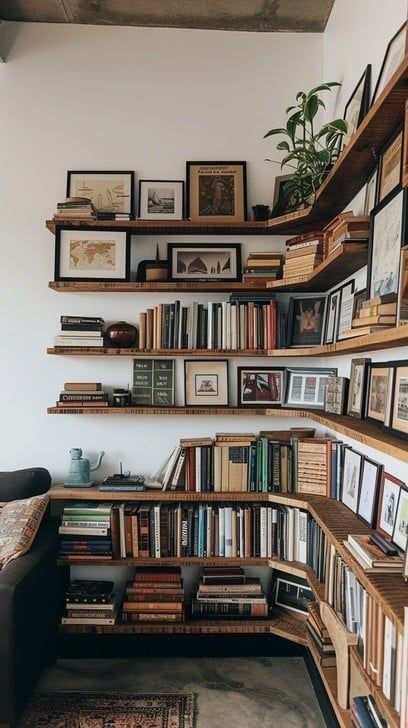
“A room without books is like a body without a soul.” – Cicero
A well-furnished bookshelf is a storehouse of knowledge and understanding. Reading good books undresses reality showing us the workings underneath. If the world were like a theatre, a good book allows us to briefly revisit the script and view the performance from the wings, so when we return to the stage to play our part, we know how to play it better.
"It does not matter how many books you have read, but how good the books are." Seneca The only true way to end this is for you to pick up a book.
I have launched my own bookshop online to sell my books written between 2013-2023. Please take the time to visit here: POEMStudio Shop
James Dazell
November 2025

Comments