
"WE" by Yevgeny Zamyatin
- iamjamesdazell
- Oct 27, 2025
- 27 min read
Updated: Oct 28, 2025

A full English copy of We can be read here
THE WORLD OF "WE"
"I will attempt nothing more than to note down what I see, what I think or, to be more exact, what we think. That's right: we and let this WE be the title of these records."
D-503, Record 1
We is a Russian dystopian novel written by Yevgeny Zamyatin sometime between 1919 and 1921 but not published in Russia until 1988. Zamyatin was denied publishing permission by the Soviet Union, so it was first published by Dutton in English in 1924 in New York.
Set in the 26th century, We is written as records (a term that has more public utility than the term journal which is individual and private). Written in the first person by the protagonist named D-503. D-503 is the chief engineer of a spaceship known as the INTEGRAL to be sent to other planets to coerce them to the Utopian ways of the OneState. Effectively, to brainwash them through literary and other artistic propaganda of the OneState. If that should fail, the contingency plan is to use arms against them. The novel is therefore the notes of a man writing from our future, writing to those of his own future, with disdain for our freedom of his past.
Everything one does is under observation by the OneState, whose supreme ruler is known as The Benefactor, and by the Bureau of Guardians (the OneState’s secret police). In OneState, people are known by numbers, rather than names. live in identical transparent glass apartments, and all wear the same uniforms, stripped of their individual identity to serve the unified whole. Even the individual term "my" is referred to as an ancestral word.
"no one is one but one of"
D-503
The OneState stands in sharp contrast to the chaotic, untamed, and individualistic world outside the Green Wall, which the OneState has worked so hard to eliminate. The OneState is a symbol of enforced, sterile, and mathematical perfection. The OneState believes happiness and freedom cannot coexist, but are two opposite things. Happiness must come at the expense of freedom, and freedom must come at the expense of happiness. Everything about freedom was considered primitive and backwards. Happiness could be mathematically and routinely designed, therefore enforced. Everything ugly is free. Everything beautiful is nonfree.
"I have read and heard a lot of unbelievable stuff about those times when people lived in freedom - that is disorganised wildness."
D-503
Freedom, therefore irrational, is represented by an equation of an imaginary number √-1. Zamyatin has D-503 deliberately call it an irrational number. The only approved literature are propaganda to the OneState. The greatest work of literature that has come down to them from the ancient is the Railroad Timetable. Organised, efficient, unemotional.
There is a comment on the sky in the beginning of the novel where the sky is immaculate because it is without clouds. it is referred to as sterile and beautiful. and refers to clouds as "untidy, clumps of mist, idiotically jostling about."
The Numbers eat a form of synthetic petroleum-based food. They don't eat from the land. Instead, they see it as a victory of scientific management and industrial production over nature. The synthetic diet is served up precisely at the moment dictated by the Table of Hours, and its consumption is a synchronized, collective ritual.
They have a pre-registered Sex Day where they are allowed to lower the blinds of their house.They exchange a pink token, and are matched with a partner, simply to have empty transactional sex for the purpose of hormonal regulation and so no one is envious of another.
There are strict rules governing who is eligible to reproduce (e.g., O-90's height disqualifies her), ensuring the purity and quality of future Numbers.
You can't go outside after 22:30 - and D-503 mocks that the ancients used to be out all night.
Dreams and imagination are considered signs of mental illness. The Great Operation is a lobotomy of the imagination, free will, and emotion.
The Museum of Prehistory is a literal and ideological structure dedicated to displaying the absurdity and backwardness of the time of the Ancients (the 20th and 21st centuries).
"Man ceased to be a wild man, only when we built the Green Wall, only when, by means of that Wall, we isolated our perfect machine world from the irrational ugly world of trees, birds, and animals."
D-503 Record 17
The Green Wall is the boundary of the city sate. Those outside the Green Wall are hairy, naked, yellow-eyed people.
The Mephi are a subversive group of radical dissenters aiming to unite the people inside and outside the Green Wall.
Over the course of the novel, the protagonist D-503 is gradually corrupted into regaining a "soul," by a woman he finds irritating and fascinating called I-330. D-503 is a conformist. I-330 is a non-conformist characterised as a kind of Parisian decadent. At first we see I-330 in a black low-cut dress, then later in yellow. She illegally drinks alcohol and smokes. D-503 feels he sees an X on her face, as the unknown is represented by an X, as the unpredictable variable. D-503 is soon corrupted by alcohol, jealousy, and an admiration for I-330's individual dissident behaviour.
"I wasn't living in our rational world. I was living in the ancient delirious world"
D-503
To capture this changing condition of D-503 through the novel, similes from the narrator in the beginning are mechanical.
"She was getting ahead of herself like a spark that fires too early in the ignition."
Later when D-503 is corrupted into regaining a soul they become more reflective of nature.
"In the opening up of the chair, she was like a bee - she had both honey and sting."
A place I-330 recurrently returns to, as a place she finds her own freedom is an Ancient House. When D-503 first arrives to the Ancient House he says "we found ourselves in a gloomy, untidy place (which they used to call an apartment)...I could hardly stand this chaos."
It’s later revealed that I-330 is the leader of the Mephi. Which are someway successful at creating chaos across the OneState and even toppling a part of the Green Wall allowing shrill birds to return.
"How can there be a final revolution? There is no final revolution. The number of revolutions is infinite."
I-330
Yet they are captured by the Bureau of Guardians. The final, decisive act of betrayal occurs after D-503 undergoes the Great Operation—the surgical removal of the center of imagination and to remove his "soul". The operation "cures" D-503, reverting him to a state of complete, rational obedience to the OneState. He is no longer capable of feeling emotion, love, or empathy.
"…now I am healthy: I am completely and totally healthy. I’m smiling: I can’t help smiling:"
D-503
When asked about the rebels, D-503 calmly and rationally reveals everything he knows about the Mephi to the Bureau of Guardians, including the names and plans of the Mephi and the identity of I-330 as their leader without feeling sympathy or remorse. This information leads directly to the swift and final crackdown on the Mephi, including the capture and torture of I-330 and the execution of R-13. The Benefactor then presides over the torture, confirming the triumph of the OneState's logic, which D-503 observes with cool, scientific detachment. D-503 watches I-330 being tortured satisfied that the state works logically and efficiency. I-330 refuses to betray her co-conspirators. Unbroken, she is executed with them. D-503 thinks of the Green Wall that has been torn down by the Mephi and the shrill birds that are entering the city, and is hopeful that eventually reason will overcome the conflict.
“I’m certain: we’ll win. For reason must win in the end.”
D-503
ZAMYATIN’S LIFE
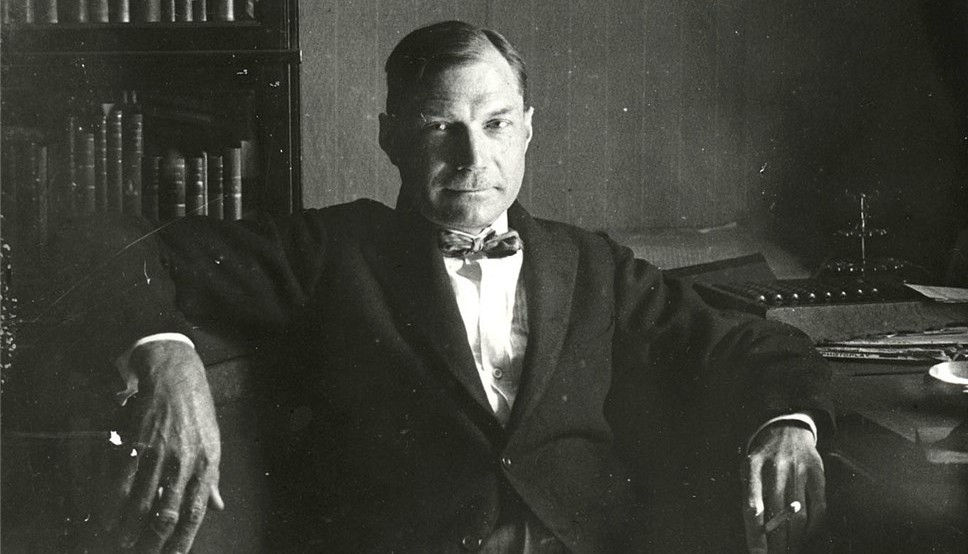
Yevgeny Zamyatin was born in 1884 in Lebedyan, around 300 kilometres from Moscow. A most Russian of towns. One that Tolstoy and Turgenev wrote of. His mother was a musician and he describes himself to have grown up “under the piano.” He began to read at the age of four. As a lonely child, he says his friends were his books. He recalls how as a child he shivered over the work of Dostoevsky, Turganev, and Gogol.
He chose the mathematical profession of naval engineering at the Saint Petersburg Polytechnic Institute. Travelling across Russia inspecting ports and submarines.
The Russian Social Democratic Labour Party was formed in 1898. As a rebel against Tsarism, Zamyatin joined the Bolshevik faction of the Russian Social Democratic Labour Party as a student. In those years, being a Bolshevik meant following the line of greatest resistance. During the disturbances of 1905 he was an activist, hiding pamphlets and weapons, and spent three months in prison in solitary confinement.
He says he began to write seriously in 1911. “If I have any place in Russian literature, I owe it entirely to the Saint Petersburg Department of Secret Police: in 1911 they exiled me from Petersburg, and for the next two years I led an extremely isolated life in Lakhta. There, in the white winter silence and the green silence of summer, I wrote A Provincial Tale.”
— Yevgeny Zamyatin
Early in 1916, the Imperial Russian government sent Zamyatin to Newcastle-upon-Tyne, Tyneside, England to supervise the building of a number of icebreakers that were to be used in Arctic waters, for the Russian Imperial Navy, now that the German Navy controlled the Baltic.
Zamyatin spent nearly two years in Newcastle where "[I] worked on my novel about the English." He produced Islanders (1918), in which he mocked the class system and hypocrisies of provincial England. The Islanders is about suffocating effect of social tradition and convention on the individual soul. A satirical critique of English middle-class conformity, and Victorian social rigidity. Zamyatin's novella, Islanders, and its follow-up, A Fisher of Men, were both written in Newcastle; We may have been started there too. The test-flight of the spaceship INTEGRAL (in We) has the atmosphere of a ship-launch in Newcastle. If it was not begun there, it certainly grew out of those experiences and reflections that informed those novellas. In England he built ships, looked at ruined castles, listened to the thud of bombs dropped by German zeppelins, and wrote novella.
"Newcastle itself is so unpleasant. All the streets, all the houses, are identical, do you understand me—completely identical, like the grain-barns in Petersburg"…"as we were driving past, I enquired, ‘What are these warehouses?’ ‘They’re dwelling-houses…’ Next day it turned out to be possible to go to London; it was about a six hour journey. And the very same identical barn-like towns flashed by. Horrible lack of imagination."
— Yevgeny Zamyatin
For Zamyatin, London was almost as horrible as Newcastle: the same regimentation and uniformity that Zamyatin satirised in his fiction.
Zamyatin found it impossible to integrate with English society. The two years in England during the war changed him and he describes himself to have become altogether different. What had happened during that time was the civil war between anti-communist groups and the Bolsheviks. The victory of the Bolsheviks created the Russian Communist Party. When the English newspapers broke out with huge headlines, abdication of tsar! and revolution in Russia, Zamyatin could no longer bear to remain in England. In September 1917, he returned to Russia.
“I regret that I did not see the February Revolution and know only the October Revolution.”
— Yevgeny Zamyatin
For all that he felt he was an outsider, ironically, when he returned to Russia in 1917, he came to be known as “the Englishman”: He wore tweed suits, cultivated a small moustache, and smoked a pipe
He gave up technical work, for two occupations, literature and teaching at the Polytechnic Institute. Within weeks of the October Revolution of 1917, Zamyatin was denouncing the Soviet state for its dictatorial methods. He was subsequently arrested and interrogated by the Cheka in February 1919, then again in May under suspicion of colluding with members of the Socialist Revolutionary Party in a supposed plot against the regime. The Cheka were the Soviet secret police founded by Lenin in December 1917; their size was about 40,000 troops in 1919.
Significant to mention, Frederick Winslow Taylor was an American mechanical engineer who pioneered Scientific Management (often called Taylorism). His core philosophy was that all work could be broken down into precise, repeatable, and quantifiable steps to achieve maximum efficiency. The Bolsheviks, particularly Vladimir Lenin, were initially critical of Taylorism's capitalist roots, but the Bolsheviks saw Taylorism as a neutral, scientific tool that could be repurposed to build socialism faster and more efficiently than capitalism ever could. It was the scientific path to achieving the utopian promise of abundance.
The Ruling Tsar since 1894, Nicholas II's conservative nature was a critical factor to his downfall. His reluctance to embrace modernisation and industrial reform stemmed from his belief in absolute autocracy and the divine right of Tsars. He was conservative minded and reluctant to push Russia into a modern industrial state. The reason there is both a Tsar and political parties at the turn of the century is due to the October Manifesto for a compromise of peace after the riots from Bloody Sunday in St Petersburg. In 1902 the party divided into two with Lenin leading the Bolsheviks (meaning "majority"), and the Mensheviks (meaning "minority") who were less radical. The Bolsheviks advocated for a small, centralized party of professional revolutionaries to lead a sudden seizure of power. The Bolsheviks didn’t just believe in communism but believed in the imminent collapse of capitalism. The land was poor, people would quite easily believe that a modern industrialised Russia would be a way to happiness. Tsar Nicholas II fundamentally opposed the very existence of such political activity and sought to undermine it entirely. When Russia was defeated in the Russo-Japanese War 1905 it led to protests and strikes against the Tsar. At the time of WWI, Russia didn't have a powerful military and suffered losses against Germany, leading to further protests against the Tsar.
The Bolshevik promise was not just communism; it was an end to economic suffering, war, and class strife—the final, perfect solution to human history. For a starving population, this promise of a scientifically managed abundance and equality of outcome became synonymous with absolute happiness. This conservative resistance made the Bolsheviks' promise a modern, industrialised socialist utopia incredibly appealing to a poor, agrarian, and long-suffering population. The Tsar was now unable to use the army against the protests because the army was now joining these protests against him. In 1917, the Tsar abdicated, and exiled peoples were able to return. Lenin returned from exile in April 1917 and published his April Theses, immediately advocating for an end to cooperation with the Provisional Government and demanding "All Power to the Soviets." The Petrograd Soviet was a mass council of workers' and soldiers' deputies formed during the February Revolution. The Bolsheviks, through persuasive organisational work achieved a majority in the Petrograd Soviet in September 1917, making it the legitimate power base for the subsequent armed seizure of power. After the Bolsheviks seized power over their opponents, and fearing counter-revolution in the former capital, they officially moved the capital from Petrograd to Moscow in March 1918.
The USSR was established in 1922, and In 1924 Stalin took power. Unable to be published, his long-running play The Flea was pulled from the stage; a volume of his collected works was denied publication; and his books, stories, and essays were removed from libraries, catalogues, literary histories, and syllabi, joining the swelling ranks of literary desaparecidos. Attila, a tragedy that Zamyatin believed “would finally silence those who were intent on turning me into some sort of an obscure artist,” was cancelled just before its opening
In September 1929, Zamyatin resigned from the Soviet Union of Writers, and in June 1931 wrote to Stalin requesting permission to leave the country for Paris under the premise that to be a writer denied of publication was an undeserved death. In his letter to Stalin in 1931, asking permission to emigrate, he claimed to be able to write English almost as well as Russian, and said that he might end up as an English novelist, as the Polish author Joseph Conrad had done. Maxim Gorky interceded on Zamyatin’s behalf, and his request was granted. He attacked the Bolsheviks from the time they seized power, but declined to join any of the émigré factions in Paris and remained a Soviet citizen and seems to have regarded himself to the end as a Soviet dissident. Accompanied by his wife, Lyudmila, he left Russia in November 1931 and settled in Paris, where he died in poverty six years later of a heart attack in 1937.
We was finally published in Russia in 1988 as part of the last Soviet General Secretary Mikhail Gorbachev's reformist policies.
DYSTOPIA AND UTOPIA

First published by Dutton in 1924 in New York. Later, Chekov Publishing House published "Мы" in Russian in 1952 outside of Russia. Zamyatin had only shown We to close friends. The greatest literary power of We is that the reader and narrator find each other’s worlds undesirable. The reader appreciates their world because of what they see lost in the 26th century.
Maxim Gorky, who was his sponsor, later said “Zamyatin is too intelligent for an artist, and should not allow his recent feeling to direct his talents to satire. We is hopelessly bad, a completely sterile thing its anger is cold and dry. it is the anger of an old maid.” In many ways I’m inclined to agree. I don't find that We is well-written. I don't find the characters relatable. I don’t think the plot is very interestingly told. But I find the meaning and motivation behind it to be extremely important.
The problem I found is that the novel is sterile. It doesn't lift of the page with the energy one wishes because it is indeed depicting a sterile future. Since it's a first-person narrative it has to embody that world in the words of the narrator. This is both a failure and a stylistic choice in my view. It isn't enjoyable to read. To read it, is to engage with a dystopia subjectively rather than objectively. And therefore, the reader doesn't go anywhere interesting because they simply return to their own feeling of being human by the middle of the novel, but by the end they once more return to the unfeeling sterile language of the narrator. It should firstly and primarily be an enjoyable read, and secondly or even thirdly be concerned with what it has done artistically in its deliberate choices.
But as I say, it's the meaning of the novel which is so extremely important. As with all great Russian novels, We is not a conflict of characters, but a conflict of ideas. Zamyatin’s novel shows a nightmare that results when an "I" is completely annihilated and absorbed into the uniform, dehumanising "We" of the state.
The novel's Russian title, “Мы” (We), immediately establishes its theme. Yet the only one who truly uses the term “we” is the authority who leads it, The Benefactor, in which it inherently ceases to carry the meaning “We” and becomes “Them.”
There is a possibility the title of the novel derives as a reference to publications from the Proletkult (Proletarian Culture Movement) a radical, state-sponsored cultural organization active from 1917–1925. Its core goal was to forge a new, uniquely proletarian culture based on collective values, industrial technology, and the rejection of all "bourgeois" individualist art. Proletkult celebrated the machine, geometric order, and industrial efficiency—the very ideals of Taylorism and Fordism that the Bolsheviks embraced. This was reflected in their art and titles, and had many publications simply titled “Мы” (We).
There is no question either that Zamyatin was writing a criticism of Leninism, as well as the utopian spirit with which Russia was perceiving its post-Tsar future. However, due to the influence of We on Orwell’s Nineteen Eighty-Four and its criticism of totalitarianism, which Orwell’s Nineteen Eighty-Four overtly strikes at the Soviet Union, We finds itself mislabelled as a criticism of the Soviet Union. The Soviet Union didn't actually exist the time Zamyatin had completed We between 1919 and 1921, as the USSR wasn’t established until 1922.
Some of have called We the first science fiction dystopia. I don’t quite fall into that boat. But whether we were searching for the first dystopia on the premise of either Dosteovsky’s Notes from Underground, or Zamyatin’s We, we must consequently find the first dystopia in the first idea of a utopia.
The first use of the word Utopia was by the English writer Thomas Moore in 1516 in the work "Utopia" Thomas More's idea of a utopia stems from the current economic and societal issues in Tudor England. But arguably as far back as Plato's Republic.
A Utopia is a state designed out of idealism, motivated to eliminate characteristics of human behaviour one does not like. Utopias aim to direct human behaviour in a certain direction and since they are naive to human behaviour they contort it forcibly. Dystopias are the experience of Utopias. The fundamental motivation behind a Utopia is a lack of wisdom. Every Utopia depends on control. Control because one does not understand the human environment around them.
Zamyatin's ultimate critique is that the ideals of the modern world—rationality and scientific mastery—are the forces ultimately leading to inhumanity. A human is not a rational animal. A human is an irrational animal that can count.
"only machines make no mistakes, and they produce only dead things…The alive-alive are constantly in error, in search, in question, in torment"
Zamyatin from "On Literature, Revolution, Entropy, and Other Matters" (1923)
Whenever you try to control human behaviour, you make it sick. it must be left free, and we must learn its behaviour to navigate it well. Not to control it. Are we today walking into an algorithmic machine made doom of human values and instinct..?
The OneState is the system that achieved this scientific mathematical perfection. By showing D-503 (a brilliant engineer) design the INTEGRAL (a vessel to spread this "happy" philosophy of efficiency) and eating synthesised petroleum food, Zamyatin shows that fulfilling the Bolshevik dream leads not to freedom, but to a soul-crushing, sterile efficiency.
Yet the OneState is not merely a critique of Russia, but a projected fusion of the Bolshevik political blueprint with the Western industrial mechanism. The novel argues that any system driven by the single-minded pursuit of a rational model will result in the loss of freedom and the obliteration of disruptive passions, proving that everything beautiful is nonfree.
Dostoevsky’s Notes from Underground (1864) already made this argument. For Dostoevsky’s underground man, a society founded on logic and science (if such a thing was possible) would be a spiritual prison. This is highlighted by the Crystal Palace. There is no question that Zamyatin followed in that book's direction, the influence of Dostoevsky is evident on every page. To embrace adversity and suffering was an essential part of human freedom. The OneState is the completed Tower of Babel foreseen by the Grand Inquisitor of The Brothers Karamazov as the final solution to the riddle of history.
But as I say, the text itself was as much inspired by English and American society and industrialism as by the Russian. It is about a general human society at the turn of the century which Zamyatin was reflecting on. The modern society which he felt was hurtling towards a fate of industrial and technological doom of human values.
Whilst Russia was excited about the prospect of turning its country around from the enveloping destitution, Zamyatin was returning from England where he did not find industrial society to bring about the happiness which homeland brethren believed it would. He's both criticising the utopian idealism of Russia at the time but also pairing it the disillusionment of the industrial society he lived in in England. And also therefore the American industrial factories and mechanical efficiency which were being brought into Russia.
In Zamyatin’s novella Islander, he used his observation of the English "Islander" (a person contentedly imprisoned by custom) as a paradigm for all forms of stagnation. When the Bolsheviks promised a final, perfect, scientific society after the 1917 Revolution, Zamyatin recognised it as the same entropic impulse he had seen in England, only now backed by the overwhelming power of the state and cold logic. Therefore, Islanders is a precursor that establishes Zamyatin's critique of Entropy—the idea that order, when absolute, is a form of death. We then takes that principle and applies it to the extreme logical conclusion of a technologically total state.
England (The Islanders) influences the idea of social entropy: The paralyzing tyranny of custom, tradition, and decorum. The conformity and rigidity of the Numbers; their fear of the unwritten law.
America (Taylorism/Fordism) introduces the idea of industrial entropy: The obsession with rational, quantifiable efficiency and mass production. The Table of Hours and the reduction of citizens to mere mechanical units of a highly productive state.
Russia (The Bolsheviks) introduces the idea of political entropy: The dogmatic belief in a "final revolution" and the need to engineer a "New Man. "The Benefactor, the Guardians, and the Great Operation—the centralized, violent imposition of logical perfection.
In some ways, Zamyatin takes leap of the English novelists like Dickens and H G Wells, with the psychological conclusions of Russian novelists like Dostoevsky and Gogol. Taking the bleak pessimism that has always characterised English realism to its final degree. What Zamyatin did uniquely, was define the ideals of the present, the very values of the modern world, as ultimately leading to inhumanity. He wasn't critiquing the way people did something. He was critiquing a state of mind. A psychology beneath the ideals of our era.
The fundamental conflict in We is not merely political, but a philosophical battle between mathematical perfection (the ideal of the Enlightenment) and human nature (the messy reality). The OneState is founded on the belief that Reason, Rationality, and Science can manifest a perfect, organized society. This pursuit of a rational model of society is believed to guarantee happiness, which Zamyatin defines as being the opposite of freedom: This perfection is achieved by eliminating the "messy inconveniences of freedom." Everything beautiful is "nonfree". The logical outcome of this ideal is inhumanity.
If We is the first dystopia then it arose out of being anti-utopian. We is as much dystopian as it is anti-utopian. A critique of industry society and enlightenment utopia simultaneously. It wasn't just an advocation of individuality. It was a rejection of Utopian idealism, it was a rejection of the whole modern spirit to the belief of Reason, Rationality, and Science to manifest a perfect and organised society. He was more concerned with the impact of rationalism on the soul. That a society founded purely on these ideals would be a spiritual prison at the cost of our humanity. Human creativity was inextricably bound up with disruptive passions.
Zamyatin, as a founder of the Serapion Brothers literary group, championed the need for art to be independent and "heretical." He used his novel to show that when art becomes "useful" (i.e., state propaganda), it ceases to be art and becomes nothing more than a mechanical function, just like everything else in the OneState. His own essay, "On Literature, Revolution, Entropy, and Other Matters," as well as being a kind of epigraph to We, is the artist's counter-manifesto to this Bolshevik demand.
In Russia at the time, every aspect of artistic production was controlled by the state. propaganda produced celebrated the glory of the socialist government and its policies and its achievements whilst damming its enemies. All art was expected to be "useful" (propaganda), celebrating the achievements of the socialist state, the glory of the worker, and the infallibility of the party. Individualism and experimental art were condemned as "bourgeoise."
Zamyatin argues that any "perfect" system, once achieved, immediately becomes entropic and dead. Therefore, to truly live, society must constantly undergo revolution. This directly supports the Mephi's argument against the Benefactor's perfect system. This is the idea of historical revolution. There is a difference between historical revolution and political revolution. Historical revolution is a revolution of ideas. My essay on Four Phases of Culture is a theory of historical revolution.
However, I’m not someone who values political revolutions. There is no example of a political revolution which succeeded that did not put in power something more dictatorial than what was there before, because the temperament of a revolution, and specifically its most determined leader, is in no way the suitable temperament for political leadership. One cannot put a mad bull at the head of a popular revolt and then assume it will castrate itself once it rises to power; instead it continues with deaf-autonomy. Had Zamyatin lived longer, he may have written a novel that wrote less favourably of revolutions.
Though Zamyatin too believed the single-minded pursuit of a rational model of society ended in tyranny, subsequent dystopian writers focused instead on the idea of political oppression motivated by perceptions of totalitarianism and technological fetishisms, which was a new landscape for the imagination.
HG Wells, with whom Zamyatin had several meetings when Wells visited Russia 1920 and on whose work he wrote a long essay, produced some powerful dystopias alongside utopian fiction and non-fiction.
Incidentally, the US translation in English of "Yedinoe Gosudarstvo" (Единое Государство) has always been OneState, perhaps so it sounds more like a corporation, though the translation is more literally The United State. Following the English translation of We in 1924, a Czech translation appeared in 1927, followed by a French one in 1929. George Orwell reviewed the French translation in 1946, which was misleadingly titled Nous Autres, and used the book as a model for Nineteen Eighty-Four. More than anyone else, it was George Orwell who made Zamyatin’s novel We known in the West. Orwell admitted he took direct inspiration from We. Reviewing the book in Tribune in 1946, Orwell called the futuristic dystopian fable “one of the literary curiosities of this book-burning age”. Orwell believed Aldous Huxley’s earlier Brave New World (1932) “must be partly derived from it.”
Huxley claimed he had not heard of We when writing his book, which he said was a response to HG Wells’s Men Like Gods (1923). Huxley clearly read the plot but didn't grasp the meaning, by the fact he followed his Brave New World with a Utopian novel called Island (a title too similar to Zamyatin's novella preceding We called Islander. I'm sorry Huxley but no one believes you).
Huxley’s target in Brave New World was scientism rather than utopianism. But Huxley and Zamyatin were at one in thinking that a society rationally engineered to minimise discord and unhappiness would eliminate much of what is meaningful and valuable in human life. Regardless, H G Wells, E M Forester, Aldous Huxley, George Orwell, Anthony Burgess, demonstrate that English writers seem to have had a great interest in writing Dystopia. Dickens would have written a terrific dystopia had the genre been fully realised in his time. But he had no need, like Engels, since he wrote of the Bleak House of England just as it was.
Orwell's Nineteen Eighty-Four was completed in 1948 and published in 1949. England were not only an ally to the Soviet Union at that time, but the newspapers would never publish anything written in criticism of the Soviet Union. Therefore, Orwell’s criticism had to be covert. Orwell felt he completed his ambition to unite political ideas with artistic delivery with Animal Farm. The original preface for Animal Farm was discovered in 1971. Though it seems as if to be a satire taking aim specifically on the Russian Revolution, it had wider application.
An excerpt of the original preface reads:
“The sinister fact about literary censorship in England is that it is largely voluntary. Unpopular ideas can be silenced, and inconvenient facts kept dark, without the need for any official ban...not because the Government intervened but because of a general tacit agreement that ‘it wouldn’t do’ to mention that particular fact...The same kind of veiled censorship also operates in books and periodicals, as well as in plays, films and radio. At any given moment there is an orthodoxy, a body of ideas which it is assumed that all right-thinking people will accept without question...Anyone who challenges the prevailing orthodoxy finds himself silenced with surprising effectiveness."
Noam Chomsky reflected on this in his own essay “obviously this book is ridiculing the Soviet Union and its totalitarian structure. But he said England is not all that different. We don’t have the KGB on our neck, but the end result comes out pretty much the same. People who have independent ideas or who think the wrong kind of thoughts are cut out."
It was as true then as now. England has a strange pathology of a denial of its own history, which in its clinical form might simply be called "patriotism." England operates as psychological totalitarianism.
Whoever describes the world can position themselves as a leader of it. Tech companies are the ones now describing our future and defining how we are living in it with each other, naturally they have positioned themselves as the leaders of it. They are sinisterly clever because they tell the world its future which everyone prepares for that future, inevitably leading it to happen. In a kind of "conform or get left behind" mentality. Whoever possesses the authority to describe the world, possesses the authority to lead people inside that description. When the world was described by religion it was religious leaders. today tech companies describe the world. Whoever describes the world leads it. Therefore, the decline of an accessible and sophisticated literary culture is a significant attribute of a totalitarian state.
What's interesting is during the Enlightenment, England was lauded for its freedom by the French. Look at Voltaire's Letters on England, where he greatly admired English liberty, especially for its freedom of speech, tolerance, and rule of law. Having lived in England after being exiled from France, Voltaire saw the English system as an ideal to aspire to. He used his book to advocate for many of the liberties he observed in England, hoping to influence change back home.
"True literature can exist only where it is created, not by diligent and reliable functionaries, but by madmen, hermits, heretics, dreamers, rebels, and skeptics."
— Yevgeny Zamyatin
The soul can only develop in solitude and darkness, away from public view. The erosion of private space—whether through physical glass walls or digital surveillance—is the first step toward Psychological Totalitarianism, because it prevents the cultivation of the independent self.
The purpose of a literary work is to allow you to think with the soul and not just passively digest vocabulary through the eyes. A literary work is not just prose on a page to be read from first to last in the order of words. A literary work is a work of art, containing deliberate and careful artistic choices, that has a profound meaning to convey to the reader beneath and between its words. It's a conversation to comprehend and contemplate long after it has been read. A book to read once, was not worth reading the first time.
The Russians perfected the novel. Everything that can be done with it they did at its highest level. To the point that the modernists had no other choice but to experiment with form. The Russians took the prevailing direction of the novel and did everything that could be done with it. They took it to the highest potential. Literary story, with highly artistic choices, whilst also being psychologically profound, and philosophically insightful.
The novel reinforces the vital, subversive role of art and critique in resisting stagnation. The artist, the poet (R-13), the musician (I-330), and the rebellious writer (Zamyatin himself) are necessary forces of Energy against social Entropy. The reader must value and protect those who challenge the prevailing orthodoxy, as their dissent is the engine of change and vitality. The most dangerous state is the one that declares itself "final" and "perfect."
"But harmful literature is more useful than useful literature, for it is antientropic…Heretics are the only bitter remedy against the entropy of human thought.”
— Yevgeny Zamyatin
Great art is always a vital statement of a moment in time, and must be made at the great risk, audacity, and disinterest towards approval. I believe that everything great in art and culture must come by great risks, audacity, and bypass approval and anything which minimises risk, wants submission, and assessment and approval is greatly hindering great culture to arrive or thrive.
A work of art is not an expression of a moment. A work of art is an overcoming of a moment in which it is made. It is made in relation to a moment that was compelled to submit to creative power, without being a representation of that moment. Art is not an expression of reality but of human potential to become something better. Art is a means to preserve the disposition of that overcoming. So that one can return to it and uphold it. Art triumphs over the coercion to be like the mundane of the present moment.
We reminds me more of One Flew Over the Cuckoo’s Nest and American Psycho which highlights Zamyatin's critique of psychological control, conformity, and emotional suppression. Rather than Nneteen Eighty-Four, which focuses heavily on political power, history manipulation, and external brutality. Both Cukoo’s and Psycho emphasise an environment, whether an asylum or Wall Street, that has become so obsessed with order, categorisation, and external perfection that it has lost the ability to recognise or value authentic human life.
The great problem of all Russian literature ends up being the same: a problem of moral reconciliation with the world as it is. There is no end to that problem because the ideas as they are presented are unable to be reconciled. That's why I eventually turned to the Greeks, the early Renaissance, and Baroque – the wisdom that doesn’t belong to the Modern world in order to adopt an unModern mind. Thucydides was my answer to Dostoevsky. Just read the section on the civil war of Corcyra and you read human nature spread across four pages.
The Baroque period had philosophers that understood human behaviour and psychology to an almost perfect degree. One will always have the truth that one has the capacity for. The deeper the truth the less pretty the picture. The subsequent period of the Enlightenment rejects the Baroque outlook of humanity The Enlightenment instead argued that Reason would lead to a better and happier life and that humans should or do act from moral integrity. Ideals are born from a lack of capacity for honesty. It was a total contradiction of the late Renaissance and Baroque thought. As Orwell described the 18th Century man of Swift's Gulliver "bold, practical, and unromantic."
Now we have a transactional culture, where wealth seems to be the only meaning. There is no culture where a human means less than a culture of wealth; a culture about buying something and living somewhere as an estimation of one's value. If it wasn't one person that bought it, it would be another. Such an existence is relatively meaningless. No one cares how much money Shakespeare made or what he owned. People care about what he did. We have a finite number of years, not to own things, but to leave something behind.
Look past the politics, Dystopias are really about how human beings treat each other. Utopias are well-meaning but naive about how human beings are. Utopias are born out of an optimism for control. Dystopias are born out of a pessimism for humanity. Dystopian fiction is the projection of a pessimistic outlook. Dystopias nevertheless are also naive since they still believe in the redeeming quality of moral earnestness. Despite that dystopias are negative expressions of the author's own ideals, they are artistic works and therefore must speak of them in affirmation. Since there must be something interesting and exciting about that world building for the reader to enjoy, the author inadvertently celebrates the fallen world they aim to demean. On top of that, the author of a dystopia doesn't have the individualistic human qualities which they profess as valuable, otherwise they would have written something else, since a Dystopia must be born out of a feeling of imprisonment by the pessimism of the world, rather than a triumph and experience of something greater than the world they find themselves in. In other words, Dystopias are always Existential literature, rather than Ecstatic. That many believe we now inhabit a dystopian reality, the disillusioned conclusion of the ideals of the modern world, this may account for the death of dystopian fiction.
If Dystopia and Utopia are the obverse of each other then what is the answer? The answer is not to think how to live better through systems because systems will always eliminate freedom. The answer is to understand the human being. A Dystopia is as much a projection of pessimistic idealism as a Utopia is a projection of optimistic idealism. The only world idea that is neither a Utopia nor Dystopia is one without such idealism. The present chaos and unpredictability of human nature at face value. A world where comprehension of human society matches reality.
A realist view of human is brutal but honest. Human nature is innately selfish, fickle, impulsive, vain, ungrateful. If you believe in the innate goodness of human beings, you’re setting yourself up for disappointment. Some qualities are innate, whilst others are developed and learned. Kindness is a learned behaviour that operates in decorum. All the good things of human behaviour are not innate ones. Once internalised then you can navigate it, then your experience is wonderful even if the image is not. The problem is we've assigned badness to characteristics that are most inevitable in human nature. As such "goodness" as Utopias value it as, can only exist in a controlled environment of inauthentic behaviour. Human nature cannot be reduced to the divisions of moral dichotomy any more than they can be reduced to mathematical logical ones. Psychology has hopefully helped draw us away from that oversimplification.
By James Dazell
27th October 2025
England

Comments