
William Fakespeare
- iamjamesdazell
- Feb 23
- 17 min read
Unsigned Portrait of a Gentlemen (1585) 61 x 46 cm oil on oak panels.

1953, a painting of was discovered in a skip, dated “1585, age 21” and inscribed with a motto in Latin “quod me nutrit me destruit” [that which feeds me destroys me]. The confirmed sitter is unknown, but it was quickly declared as a painting of the most innovative dramatist of the English language, Christopher Marlowe. Not only the enigmatic smile, wild hair, arms folded confidently across his body, and the fashionable clothes have allured people to put this face to his name. The dating further intrigues confirmation, since Marlowe was indeed twenty-one in 1585, and in Cambridge where the painting was discovered in 1953. However, the dating, as is more often the case, may instead record the age of the painter. In any case, it has since become the only potential image of the great English literary rebel, Chrisopher Marlowe. To tell this story, I have to first begin with Marlowe.
Christopher Marlowe, the rebel writer, Shakespeare's foremost influence. Marlowe accomplished scholar, playwright, poet, spy. Marlowe is the dramatist of challenging the established order and conventional mortality. With such consistency that his plays are not autobiographical but an imposition of his spirit. Born in Canterbury in 1564, the same year as William Shakespeare (yet he in Stafford-Upon-Avon), Christopher was the son of Kathryn and John Marlowe. Shakespeare and Marlowe were much of the same social class.
During the 16th Century, England underwent a radical change of religious authority. England separated from the Roman Catholic church in 1534 so Henry VIII could divorce his wife, and set up the Church of England with himself at the head of the Church. Yet England returned to Catholicism under Mary I in the 1553. Then reverted back to Protestantism under Elizabeth I in 1559. Even this Protestantism wasn't stable. England was at first followed the Protestantism of Luther, then it embraced and then rejected Protestantism of Calvinism. Therefore. the religion of the country therefore changed at the will of those in political power. It was hardly surprising Marlowe was sceptical and atheistic.
Marlowe attended the King’s School in Canterbury and then Corpus Christi College, Cambridge, on a scholarship intended for training clergy. Yet by the scholarship, Marlowe enrolled to Cambridge as a student of Divinity. Recognised for his intelligence. One might think of Michelangelo taken into the House of Medici for his recognised talents.
At Cambridge, Christopher "Kit" Marlowe, met poets, Robert Greene (who later wrote a polemic against Marlowe), Thomas Nashe who he wrote is first play with. It was important at Cambridge not only to be educated in the classics and Latin, but to translate from Latin to English and back to Latin. Marlowe's literary career began in the early 1580s at Cambridge with translations of Ovid, and his first known play Dido and Aeneas, modelled primarily on the events from Virgil's Book IV of Aeneid.
Cambridge struggled with him: he was repeatedly absent, disappeared to the Continent, and rumours circulated that he had gone abroad “without licence.” The Privy Council [[a formal body of advisors to the monarch in the United Kingdom] eventually intervened on Marlowe’s behalf, praising his “faithful dealing” in matters “touching the benefit of his country.”
Marlowe was often absent from college. Some 32 weeks we find Between 1584-85 he was absent for 32 weeks. There was a committee insistent of preventing him from doing his Master degree. There was speculation that Marlowe wanted to go to Rhiems and join the Catholic circles. This accusation reached the top level of the English Government System. But the Privy Council intercepted and told the college to allow Marlowe to do his Masters, as his connection with Rhiems was on behalf of good duty to the State.
This is the closest we get to confirmation of what scholars long suspected: Marlowe was involved in espionage, working for the secret service spying on the Catholic circles of Europe; likely low-level intelligence work under Walsingham’s network. Catholics at this time were persecuted in Europe, and to reject Protestantism in favour of Catholicism was seen as a traitor to the country. Marlowe was once arrested for counterfeit coinage in Holland, and for killing a man in a street brawl. Yet in both cases was soon released by intervention from the Privy Council. It helps explain the worldly confidence and political boldness in his writing; Marlowe had lived among dangerous men and dangerous ideas.
The writer Thomas Kyd was slightly older than Marlowe. Kyd was born in 1553 a near contemporary of the poet Edmund Spencer. Unlike Marlowe, he did not attend university—placing him in the “grammar school dramatist” class alongside Shakespeare and Jonson. In 1590s Kyd was sharing a residence with Christopher. The pair were famously nicknamed Kit and Kyd. Kyd was writing for the Lord Strange’s Men and Kit for the Admiral’s Men. Kyd's only known play is The Spanish Tragedy a play Shakespeare is famously indebted to for his Hamlet.
London in the 1590s was a walled city of about 200,000 people, but the "theatre district" (the Bankside and Shoreditch) was a small, tight-knit community of actors, writers, and patrons who all drank at the same taverns and worked in the same few playhouses. Writers would meet at a tavern (like the Mermaid or the Boar's Head) to decide on the structure of the play.
From shoemaker's son to international spy for England, was repeatedly released from arrest by the Privy Council, Marlowe must have felt a parallel of aspiration and awe as he depicts in Tamburlaine's own unbridled ambition. Kyd described Marlowe as being cruel at heart, irreligious, and intemperate. Everything we see of his characters.
Marlowe was linked to alleged group of free-thinking intellectuals, accused of atheism and radical ideas, alongside figures like Sir Walter Raleigh, Thomas Harriot, Matthew Roydon and George Chapman, known as The School of Atheism.
It is alleged that each of these men studied science, philosophy, and religion, and all were suspected of atheism. Atheism at that time was a charge nearly the equivalent of treason, since the English monarch after Henry VIII's reforms was the head of the Church of England, and to be against the church was to be against the monarch. However, it was also a name for anarchy, and was a charge frequently brought against the politically troublesome. Atheism being against them was also against the god given right of the king and therefore was a form of anarchy. So it can just as rightly be called The School of Anarchy.
In 1593, anti-government, anti-immigrant pamphlets appeared in London under the name “Tamburlaine”. The authorities launched a wide investigation into dissent, atheism, and seditious thought. Suddenly playwrights were under scrutiny. Kyd arrested for free thinking. During interrogation, the authorities found in Kyd’s lodgings a heretical document—likely a manuscript discussing the nature of the Trinity, the soul, and materialist philosophy. Kyd under torture, effectively implicated it belonged to Marlowe. Marlowe revelled in free thinkers like Thomas Harriot, and Giordano Bruno.
A most important member of Sir Walter Raleigh’s circle was the advanced thinker, brilliant mathematician and astronomer, Thomas Hariot. He was in the patronage of both Raleigh and the Earl of Northumberland, the latter nicknamed the “Wizard Earl” for his love of experimenting with chemistry for which he had laboratories built into all his houses.
Hariot, who has been called “the greatest scientific mind before Newton”, was in secret correspondence with Johannes Kepler, who discovered that the orbits of the planets were not circular but eliptical. Hariot was Marlowe’s friend in this circle, with whom he was often seen browsing at the bookstalls in St Paul’s churchyard. We can see evidence of the influence of Hariot on Marlowe’s Doctor Faustus.
The model for tragedy at this time in England, was the Ancient Roman Latin writer Seneca. Who penned philosophy and plays. Therefore, there is much more emphasis on rhetoric than Ancient Greek tragedy. It’s unclear if Seneca’s plays were even staged at all, or if they were meant only to be read aloud (which is today called a closet drama).
Acting in the modern world developed out of oratory. Theatre directors over the past two centuries complain of the dominance of the text rather than the visual but that's due to the changing nature of the theatre. In the Ancient world and the Renaissance, theatre was a bare stage. There were stage mechanics, costumes, and props but not the stage design we're expecting of today and the parts were staged in the day rather than in the dark. He chose blank instead of rhymed verse.
Marlowe wrote his major works in rapid succession:
· Dido, Queen of Carthage (1587) (with some contribution to Marlowe's fellow student and poet Thomas Nashe)
-Tamburlaine Part I (1587) Tamburlaine is the first example of blank verse used in the dramatic literature of the Early Modern English theatre.
-Tamburlaine Part II (1587–88)
-The Jew of Malta (1589)
-Doctor Faustus (1589-90)
-Edward II (1591–1592)
-Hero and Leander (poetry 1593)
-Pharsalia Book 1 (translation 1593)
-The Massacre at Paris (unfinished) (1593) thought authorship is contested, or could even merely be a reconstruction from memory.
He apparently wrote three plays with William Shakespeare before his death in 1593. Henry VI parts 1-3. Both men were connected to the Earl of Southampton and the Earl of Pembroke.
The prelude to Marlowe’s arrest in 1593 on a charge of “Atheism” was the incidence of riots by the London apprentices against the Huguenot settlers whom they saw as threatening their livelihoods with their skilful trades. The quelling of riots was in the legal province of the Court of the Star Chamber, the dreaded higher court which also dealt with matters of heresy and was the English equivalent of the Holy Roman Inquisition. It was the only court empowered to use torture to obtain confessions, and operated without a jury. It represented the all-powerful legal arm of the most reactionary elements of Church and State.
In early May 1593, several bills were posted about London threatening the Protestant refugees from France and the Netherlands who had settled in the city. One of these, the "Dutch church libel", written in rhymed iambic pentameter, contained allusions to several of Marlowe's plays and was signed, "Tamburlaine".
On 11 May 1593 the Privy Council ordered the arrest of those responsible for the libels. The next day, officers of the Star Chamber searched the rooms of Marlowe’s fellow dramatist, Thomas Kyd, who had been involved in writing the collaborative play Sir Thomas More (lately rejected by the censor because it contained scenes of riots considered to be inciting), and among Kyd’s papers they found incriminating evidence in the form of a treatise discussing the Holy Trinity which was immediately labelled as “Atheism”. Poor Kyd was hauled off to prison to be put on the rack in a process known as “scraping the conscience”. Under torture he stuck to his original claim of innocence and stated that this paper belonged to Marlowe, who had been writing in the same room with him and had left it there accidentally, and had become “shuffled” with Kyd’s own papers “unbeknown to him."
A warrant for Marlowe's arrest was issued on 18 May 1593 when the Privy Council apparently knew that he might be found staying with Thomas Walsingham, whose father was a first cousin of the late Sir Francis Walsingham, Queen Elizabeth I’s principal secretary in the 1580s and a man more deeply involved in state espionage than any other member of the Privy Council. Marlowe then presented himself on 20 May 1593 but there apparently being no Privy Council meeting on that day, was instructed to "give his daily attendance on their Lordships, until he shall be licensed to the contrary.”
Marlowe was due to defend himself before a tribunal. On Wednesday, 30 May 1593, a few days before the tribunal, he met with several secret service men in a Deptford lodging house owned by Eleanor Bull. The three men were named Ingram Frizer, Nicholas Skeres, and Robert Poley. At that time, if you wanted to leave the country, it was feasible to go to Deptford to first get on a boat. They drank, they played board games, they walked and rested in the garden. Later that day, Christopher Marlowe was killed. Allegedly over a dispute about paying the bill. He was killed by his own knife through its brain, allegedly by Ingram Frizer.
It seems an unlikely assassination since they were all drinking together all day. It seems too lengthy and procrastinating for a planned assassination. That Marlowe met them and drank with them all day, demonstrates a total lack of suspicion towards them. It sounds more like a farewell gathering. A departing. For Marlowe to be sent permanently to Europe, yet remain a spy for England. Maybe they aimed to straighten things out, perhaps they tried to get a confession but not under torture, or maybe Marlowe gave himself a dramatic death. A knife through the very instrument [his brain] of his wit that earned him such success.
The jury concluded that the Ingram Frizer acted in self-defence and within a month he was pardoned. Marlowe was buried in an unmarked grave in the churchyard of St. Nicholas, Deptford, immediately after the inquest, on 1 June 1593. It has also been discovered more recently that the apparent absence of a local county coroner to accompany the Coroner of the Queen's Household would, if noticed, have made the inquest null and void.
Without fingerprints, photographic evidence back then, faking a death [of Marlowe or Kyd] and replacing one body with another, seems hardly a difficult task, especially for one so connected to government. I find the theory too tantalising a story to rule it out completely. And the idea that once Marlowe died, and the plays were insufficient to their same weight of greatness, Shakespeare retires the stage abruptly and ceases to write.
Marlowe's biographer John Bakeless acknowledged that "some scholars have been inclined to question the truthfulness of the coroner's report. There is something queer about the whole episode," and said that Hotson's discovery "raises almost as many questions as it answers."
Marlowe allegedly died aged twenty-nine. He completed five of some of the best plays in the English language. At that time he was more influential and imitated by far then was Shakespeare. Tamburlaine is my favourite of all English plays, yet I could not say it was the best. But what is accomplished in poetry and characterisation is unparalleled.
WILL SHAKESPEARE
Marlowe likely met Shakespeare as an actor and may have even acted in one or some of Marlowe's plays. If Marlowe hadn't died at twenty-nine, the history of English literature would look completely different.
Who knows if Marlowe had lived what Marlowe’s mature period would have been. He is likely to have continued in the genre of tragedy, as he never wrote a Comedy, and wasn’t particularly good at comedy within his works. But when he is in his tragic zone, I think he surpasses Shakespeare for the lack of existential conscience on his character’s mind. Shakespeare’s figures implode into interiority in ways that Marlowe’s don’t. They are far more ancient in their apostrophising (which is when characters externalise their emotions, projecting them onto the external world, rather than diving into interiority).
We often think of Shakespeare as a solitary genius because of the First Folio (1623). This book was published after his death and presented his plays as the work of a single man to make it more marketable and prestigious. However, modern computer analysis, notably the New Oxford Shakespeare (2016), has revealed that about one-third of "Shakespeare's" plays likely contain the work of other writers.
-George Peele is now widely credited with writing the entirety of Act 1 of Shakespeare’s Titus Andronicus.
-Thomas Kyd wrote parts of Edward III.
-Thomas Middleton likely revised Shakespeare’s Measure for Measure for a later revival, the same with Timon of Athens. Middleton also added the Hecate scenes and songs in Shakespeare’s Macbeth.
- John Fletcher is officially credited on the original 1634 title page of The Two Noble Kinsmen, and is believed to have written more of the final text of Henry VIII (All Is True) than Shakespeare himself.
-Shakespeare likely wrote the last three acts of Pericles but the first two acts were written by a tavern owner named George Willkins.
-Anthony Munday & others wrote Sir Thomas More.
This idea of the lone genius English poet-dramatist, gave rise to the Romanticism of later years. In the Elizabethan and Jacobean eras, writing a play was less like writing a novel and more like developing a TV show or a movie script today. It was a high-speed, commercial industry where collaboration was the "default" setting for several practical and economic reasons. Plus, since the company owned the script, they felt free to hire other writers to polish, augment, or modernise it years later.
Plays were developed not only through the theatre group of actors, but there were workshops of writers, in the same way that painters had workshops of painters. One writer would take home a "plot-sheet" and write specific scenes, then bring them back to the group to be stitched together. Since Shakespeare was also an actor in the company, he would have been physically standing in the same room as Marlowe while they polished the script. Not every writer was good at everything. Before the Globe was built, the primary theatre was The Rose, managed by Philip Henslowe. Theatre managers like Philip Henslowe (whose diary provides our best records of this era) often hired writers for their specific strengths: Records show that Marlowe's The Jew of Malta and Shakespeare's early plays were being performed by the same companies (like Lord Strange's Men) in the same building.
A playwright sold their script to an acting company for a flat fee (roughly £6). Once the money changed hands, the company owned the play, not the writer. Even the publicity for the play would not have the writer's name on, but the theatre company, and possibly the actor. There was no director. Often this fell to the lead actor and the company as a whole. Actors would edit the script as they want along to flow or other necessary improvements to the performance. Common knowledge now, but worthwhile to say, the only actors at this time were men, playing all male and female roles. The 18th and 19th-century "Cult of Shakespeare" created a false version of him, masking the perception of the collaborative reality of the Elizabethan theatre. What we see is Shakespeare collaborating with more established writers in his early career (1589–1594), largely writing on his own in his middle career (1595–1608), and co-writing as a mentor to the next generation in his late career (1609–1614).
Shakespeare’s foremost influence was Marlowe. Shakespeare directly quotes Marlowe in a couple of works. In As You Like It, Shakespeare quotes from Marlowe's Hero & Leander. In Act 3, Scene 5, the character Phebe says:
“Who ever lov'd, that lov'd not at first sight?'"
In Romeo and Juliet "give me my sin again" then they kiss, Shakespeare almost directly quotes from Doctor Faustus "give me my soul again" then they kiss.
The Merchant of Venice: The character of Shylock is heavily influenced by Marlowe’s The Jew of Malta (Barabas).
– The Jew of Malta becomes Merchant of Venice
– Dido & Aeneas becomes Anthony & Cleopatra
– The 10 act Tamburlaine becomes the economically swift 5 act Macbeth
– Doctor Faustus becomes The Tempest
– Hamlet requests from the theatre players, a speech to be given, which is Dido & Aeneas
Some have suspected the comparison of Shakespeare's subsequent plays after the death of Marlowe and Kyd is too uncanny. The Spanish Tragedy is unanimously acknowledged as being the foundational influence for Hamlet.
The New Oxford Shakespeare, one of the most authoritative editions of the Bard's work, now officially credits Christopher Marlowe as a co-author on all three parts of Henry VI. This decision was based on data stylometry—using computers to analyse patterns of word usage, sentence structure, and linguistic fingerprints that distinguish one writer from another. The Jack Cade rebel scenes in Henry VI Part 2 are now widely attributed to Marlowe.
Early Career Collaboration: Henry VI was written very early in Shakespeare's career (around 1590–1592). At that time, Marlowe was the more established "superstar" playwright, and collaboration among writers was a standard practice in Elizabethan theatre.
About ten years ago I had the theory that Marlowe faked his death, travelled abroad to continue to spy on Catholics on the continent, continued to write his plays but in drafts which allowed him to be more prolific, and sent them back to London, where Francis Bacon received them and edited them with several other writers including additions of his own. This included those from the School of Anarchy. The project was a Renaissance project to bring the best minds together to create a world within the theatre. Assimilating an aphoristic style of philosophy of Francis Bacon, with the existential gaze and moral revenge of Thomas Kyd, with the keen determination of grand ambition and the poetry of Christopher Marlowe all wrapped up together that could be smoothed out and refined by a workshop of writers, passed into the hands of an actor named Bill Shakespeare to give to the Lord Admiral's Men. Bacon was deeply interested in rhetoric, staging, the power of language, and the theatre was the most dynamic language laboratory of ideas of the age. My verse on this I wrote was:
The greatest writer to take the stage
Was but a fraud and duped the age.
A great imposter from persecution days.
'twas Durham House what wrote the plays.
Free-thought imprisoned save by theatre's fame.
So Raleigh had the gall to invent a name.
"Caught with heretic talk would meet the gallow'
No - talk deep where talk is often shallow.
To spare being sent to deathly shade,
On the public stage speak unafriad."
Expressed in verse before did Raleigh die
He proudly writ "give them all the lie"
His School of Night behind closed doors
Whilst Kit and Kyd were now abroad.
Both faked their death to 'scape death
Then escaped on feet as light as breath.
So William Stanley and Edward de Vere
Gave patron to a expat queer.
Found an upstart young actor - need of cash
Gave him the name Will Shakespeare.
Newfound ideas and progressive thought
From collected lives that no school taught.
To give a voice through a name,
To invent a playwright of public fame,
And with Bacon's help to pen a thought
Upon a play that Kyd and Kit had wrought.
This way their thought went to the public world
And the culture of Durham House unfurled.
Could expound new wit and tale of greater taste
And revive the ancients lest they fell to waste.
And new thought so long imprisoned would now be free
And breathe in airs of new liberty
And make a theatre that could make men
If o'er time performed again and again.
The English government, particularly through Sir Francis Walsingham, used intelligence gatherers in Italy in the late 1580s to monitor Catholic activities and the Spanish Armada's preparations. Records from the late 16th century, particularly between 1559 and 1600, show a steady, though complex, presence of English visitors in Rome, including seminarians, priests, and tourists. There is no direct, concrete evidence (such as travel documents, letters, or diary entries) that William Shakespeare of Stratford-upon-Avon ever traveled outside of England. Yet twenty-five of Shakespeare's thirty-eight plays are set outside of England, with Italy being the most frequent location, mostly within Lombardy and Veneto. This may well be a fascination for the exotic, and a love of the Italian sources that inspired much of Shakespeare's plays. Marlowe worked that way after all. But Marlowe travelled a lot.
It was Miss Delia Bacon's theory that Francis Bacon wrote the plays and gave them to William Shakespeare. I disagree with this theory, for its exclusivity of Bacon. It's not Bacon's voice I hear so explicitly as the voice of style of insight. The philosophical voice of Shakespeare is aphoristically Francis Bacon. The existential gaze of Shakespearean soliloquy is very Thomas Kyd. The nature of the invented tragic characters is very Marlowe. Yet not a synthesis of raw material but developed into a new idea of theatre. It's not just a supergroup, It's a Renaissance project. To bring people together and create something bigger than the sum of its parts. To achieve the heights of ancient tragedy. To set a new measure, and to go around the world showing that England is able to do this. To reach the height of ancient level of culture that the Italians had already demonstrated.
Similiar to how a skilled composer can name the note or chord, whether a piano key, guitar string, or of any resonating object like a glass tapped with a spoon. Just so, a writer has an ear to writers. Each writer has their fingerprint, an energy, a way of unfolding themselves on the page. It simply feels that which Shakespeare there are several "voices" in the works. The work is audibly polyphonic. I believe there are various contributing voices. Different skillsets that come into play to make the play what it is. If this was simply Shakespeare imitating the style of others for different aspects of the play, that would be far more amateur a way of writing than the advanced level of what the work is. This polyphony must be from multiple writers. No one can prove anything, it's all intuitive. But that's what I believe. So I was not surprised when in 2016 the highest level of Shakespeare authority accepted that Shakespeare collaborated on many of his plays, and that we accept now that Renaissance playwrights in England worked as a theatrical collective.
I don't believe this idea diminishes the work of Shakespeare. Nevertheless, they are the heights of literary theatre achievement. The work remains what it is. We have confirmed many plays were collaboratively written and we think no less of them. If anything, they become more exciting.
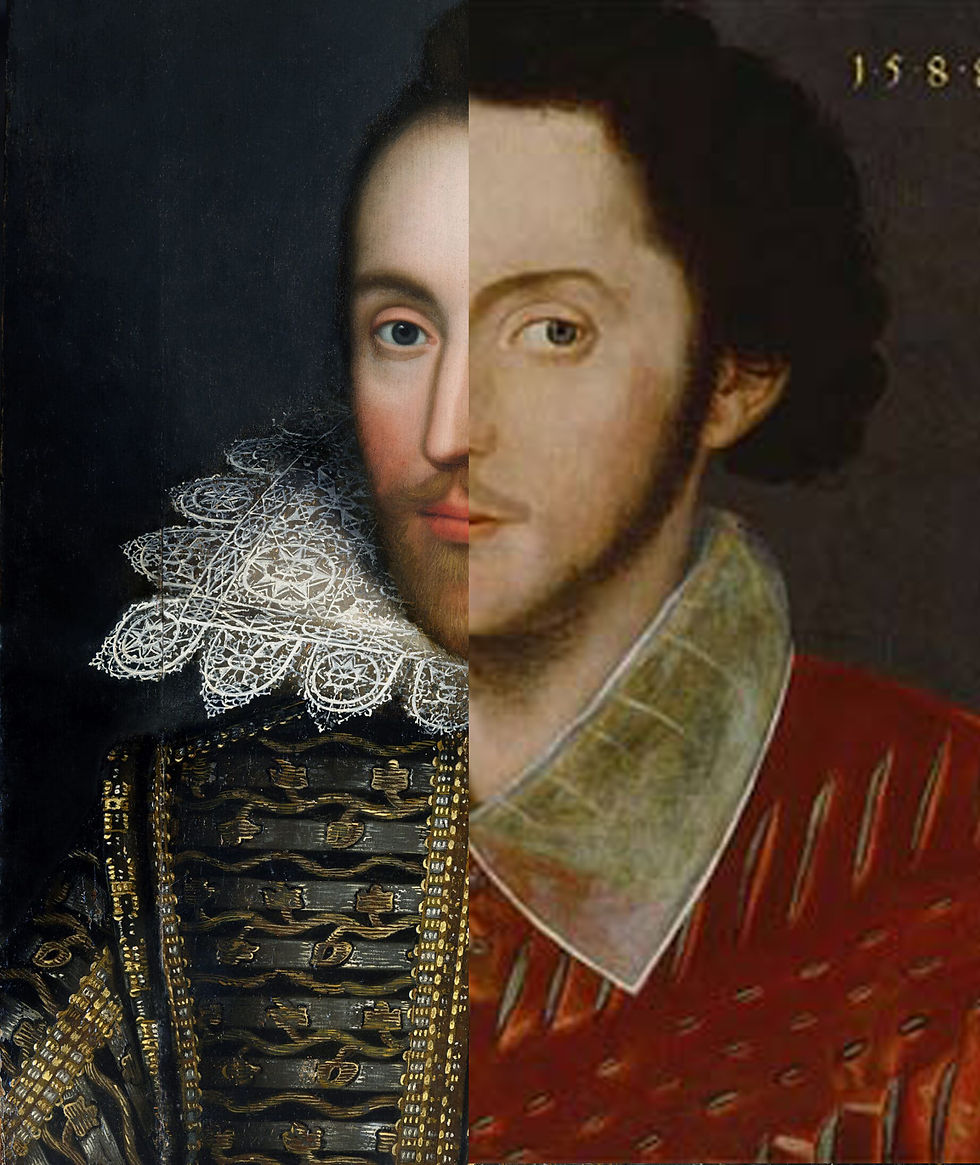
(William Shakespeare 1610 and the Anonymous Grafton portrait 1588)



Comments